




How can visually impaired and blind people shop independently in a supermarket? VIRAS supplies the answer: an autonomous shopping cart developed at the Eastern Switzerland University of Applied Sciences (OST) in Rapperswil. VIRAS stands for Visually Impaired Robot-Assisted Shopping, and accompanies users through the entire shopping process from the digital shopping list to navigating through the store and independent payment. Thanks to intelligent sensors, motorisation and precise control, supported by Faulhaber technology, the cart detects shelves, avoids obstacles and enables a barrier-free shopping experience. The goal of the project is to sustainably improve the quality of life of visually impaired and older people.
Chantal Keller is a development engineer in professor Dario Schafroth’s team at OST. “The project allows blind and visually impaired people to have a fully self-determined shopping experience for the first time,” she says.
How the VIRAS smart shopping cart works
The VIRAS smart shopping cart combines state-of-the-art sensors and intelligent software to make a safe and self-determined shopping experience possible for blind people. The entire process starts with the shopping list. In the first step, this is transferred into the accompanying VIRAS app either by entering it manually or by using a barcode scanner directly on packaging or household supplies. The autonomous navigation then starts. The shopping cart precisely localises itself in the supermarket environment and plans efficient, collision-free routes to the desired products in real time. This occurs with the help of a camera system for environmental perception as well as high-performance modules for data processing. The position of the cart can thereby be constantly adapted, allowing it to react to the current surroundings.
Once at the shelf, VIRAS activates product detection. Two laterally mounted, swivelling cameras detect the situation from different perspectives. An AI-assisted image analysis module identifies and finds the product being searched for using visual characteristics and audibly outputs its exact location. Parallel to this, a hand tracking module follows the movements of the user. Using acoustic information and haptic feedback, the hand is precisely guided to the desired item until the product has been correctly grasped. After placement in the cart, the system confirms the successful completion of the task with an audible signal. Voice control and intuitive feedback make the interaction easy and barrier-free. After all of the items from the shopping list have been gathered, the navigation system guides the user to the checkout. The result is a shopping process that combines technological precision with practical suitability for daily use.

Faulhaber makes it possible: How VIRAS moves smoothly and jerk-free
One of the greatest technical challenges in the VIRAS project was realising precise localisation and reliable 3D mapping in highly dynamic, often overcrowded supermarket environments, and doing it without external infrastructure. Another important feature of the shopping cart was that it could safely perform evasive maneuvres with respect to other people or movable objects in narrow, constantly changing aisles. To meet these requirements under real operating conditions, robust and high-performance hardware was essential.
Faulhaber offered the necessary support. The drive for the smart shopping cart used two brushless, flat DC-Micromotors from the BXT H family, including gearheads as well as the MC 5005 S motion controller. All operating and load scenarios, from the fully loaded cart to the requirements on energy efficiency and noise emissions, were taken into consideration for optimum motorisation.
Special attention was given to the development of motors that produce high starting and static torque at low speeds. The shopping cart can thereby reliably be kept on the specified route even when fully loaded, while still enabling gentle acceleration and braking operations. Also important was quiet operation of the drives to ensure that users could clearly perceive their environment without additional noise.
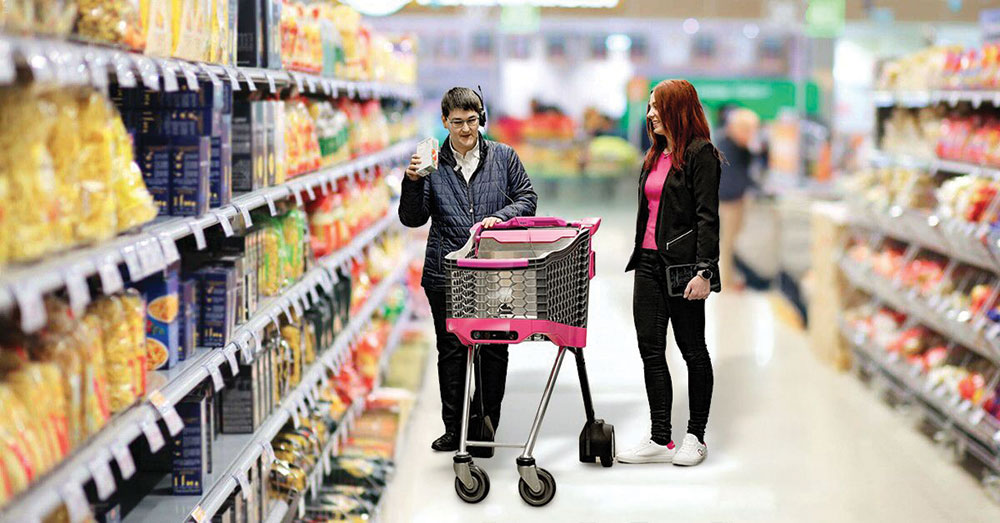
The shopping cart in a practical test
Keller explains the process involved in the development and testing of VIRAS: “The target group is actively incorporated in all phases of the project, thereby ensuring that a needs-oriented solution is developed. Instead of passive tools, an intelligent, physically supportive system is used that doesn’t act on behalf of people with disabilities, but rather offers them targeted assistance to allow them to independently manage their daily lives.”
The field tests with the VIRAS smart shopping cart supplied valuable findings about its suitability for daily use. Especially positive was the fact that the cart could provide constant torque, even at very low speeds. As a result, it was possible for the visually impaired test persons to follow the cart safely at all times. The drive motors immediately responded to input via the thumb-controlled accelerator and stopped precisely at the intended destination point in front of the shelf. The integrated four-quadrant control, which enables a gentle transition between forwards and reverse travel, avoided potential collisions.
The test persons also emphasised the low audible noise of the drive units. Thanks to the quiet motors, both audible messages from the system as well as environmental noises in the supermarket could be heard clearly. The test persons reported that they felt safe at all times and could give their full attention to the actual shopping process.
Autonomous shopping as a key to more independence and inclusion
OST impressively demonstrates how innovation and drive technology can be more inclusively incorporated in daily life. The autonomous shopping cart opens the possibility of independent shopping for visually impaired and blind people, from the digital list to safe navigation and payment. Intelligent sensors, precise motor control and reliable drive systems from Faulhaber form the technological basis. But VIRAS is more than a technical tool. The project pursues the goal of improving the quality of life, removing barriers and sustainably promoting the social participation of people with limitations.
For more information contact Horne Technologies,
| Fax: | 086 653 5225 |
| Email: | [email protected] |
| www: | www.hornet.cc |
| Articles: | More information and articles about Horne Technologies |






© Technews Publishing (Pty) Ltd | All Rights Reserved

 printer friendly version