



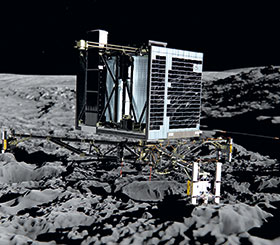
4:33 AM 14 June 2015. “Hello Earth! Can you hear me?” A lonely robot, freezing on an isolated space fragment, cheerily reaches out through Twittersphere to herald its reawakening. Seven months after being forced into hibernation, the Rosetta Mission’s Philae lander has finally stirred from its slumber on the icy surface of Comet 67P/Churyumov-Gerasimenko, some 600 million kilometres away.
In November 2014 Philae touched down to global applause as it became the first spacecraft ever to land on the nucleus of a comet; but it had come to rest in the shadow of a crater. With its solar panels unable to harvest the sunlight required to keep the batteries charged, the diminutive craft could work only 60 hours before being obligated to ‘go dark’ in the primordial wilderness it had come to explore.
Luckily Comet 67P’s elliptical orbit has now changed its position relative to the sun just enough to light up Philae’s solar panels. This breathed life back into the little comet chaser, which includes 14 Faulhaber drive systems that defied the harsh conditions of the 10-year journey through space.
The comet is not very big and the low force of gravity made it difficult to stand securely on the surface. To solve this, the Max Planck Institut for Extraterrestrial Physics developed a special anchor system; immediately after ground contact on landing, two harpoons were to be shot by a propellant charge into the surface of the comet. Barbs were provided to prevent these anchor fittings from tearing loose again. As each harpoon shot out, it would have pulled a cable out from a magazine. This cable would then be wound up on a drum by means of a Faulhaber 1628 series brushless servomotor with a 16/7 planetary gearhead, to secure the probe to the surface. At least that was the plan. Unfortunately the harpoons were not fired, the rewinding mechanism was not used and Philae ended up bouncing three times, eventually coming to rest in a crater. Nevertheless, the miniature laboratory was still able to begin its analyses as planned.
During the landing phase, other motors transformed the kinetic energy generated during the landing into electrical energy and finally into heat using a spindle drive. A Faulhaber 3557 series bell-type armature motor was connected directly through an external resistor and operated as a generator in this case.
Additional drives from the 1224 series were used in the three-legged landing gear of the craft in order to swivel or rotate the upper part by means of a cardan joint so that the solar panels could be optimally aligned. Microdrives were also needed for taking core samples and feeding them into a small oven for pyrolysis. Small 1016 series motors with 10/1 planetary gearhead drive a cam via a worm arrangement. This provides feed to a ceramic breech piece on the oven and simultaneously closes the electrical contacts for the heating element. The gas generated in the furnace is then routed to the instruments for analysis. During its first phase Philae performed all the planned scientific measurements on the comet surface and successfully transmitted the data to the Lander Control Centre before it went into hibernation. Now Philae has revived itself and is again ready to perform the galactic research for which it was designed. The European Space Agency regards the mission as a complete success.
The demands that outer space place on these drives are high: every kilo of mass that is shot into space costs energy. Therefore, small, light solutions are needed. They must also be able to withstand the enormous vibration and acceleration forces during take-off, as well as the low temperatures and vacuum conditions prevailing in outer space.
Because cost plays a major role when selecting components for space projects, the developers wanted to do without costly custom developments. Accordingly, they first looked for standard products which complied with their specifications. They found what they were looking for in the comprehensive drive systems range from Faulhaber. The standard drive solutions fulfilled all mechanical requirements and the special conditions in space could be met by making comparably few modifications at negligible additional cost.
For more information contact David Horne, Horne Technologies, +27 (0)76 563 2084, [email protected], www.hornet.cc
| Fax: | 086 653 5225 |
| Email: | [email protected] |
| www: | www.hornet.cc |
| Articles: | More information and articles about Horne Technologies |






© Technews Publishing (Pty) Ltd | All Rights Reserved

 printer friendly version