


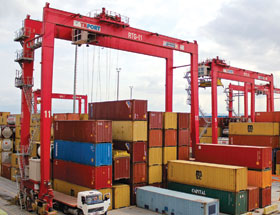
Powermite has introduced the Lasstec Load sensing and operational safety system. This latest innovation from Conductix applies the twistlock method and delivers an accurate, versatile, efficient, economical and safe port and container handling solution that is compliant with the new International Maritime Organisation (IMO) legislation for mandatory container weight verification.
Powermite is a specialist supplier of electrical and mechanical equipment for moving machinery. The company became involved in supplying equipment such as ship-to-shore loaders and electrified rubber tyre gantries (ERTGs) as a consequence of a partnership forged with the French multinational, Delachaux and its Conductix-Wampfler operation – a global supplier to the materials handling industries. “Our materials handling division has been a distributor of Conductix’s quality range of products including drag chains, cable reelers and slip-ring housings for over 40 years,” says Powermite director, Donovan Marks.
Inadequate control of the weight of individual shipping containers and container weight distribution on a loaded ship has severe safety implications as it can lead to ship overloading and instability at sea. Consequently the IMO decided to make container weight verification mandatory and recently approved the SOLAS (Safety of Life at Sea) amendment, which when implemented globally in Q3 2016 will make it the shipper’s responsibility to declare the correct container weight. The efficient time and cost saving Lasstec system is a more practical and economical alternative to weighing bridges that provides on-the-go weighing without interruption to the terminal operation or the need for infrastructure changes.
Using twistlock and fibre optic technology, the load sensing system accurately records container weight and also provides invaluable weight distribution data which enhances the safety and accuracy of the stowing plan. “Twistlock has been around for many years and is proven technology,” says Marks. “The system measures the strain (extension) of each twistlock of single- and twinlift spreaders as well as mobile harbour crane applications during a lift. It uses these measurements to determine accurate load measurements from each corner of each container. As load measuring on each twistlock is done during the normal load cycle, there are no delays or interruptions to the load cycle. The actual weight is sent into a central data processing unit from where the information is distributed to the crane PLC and the TOS, enabling accurate weights to be used in the ship loading plan.” The system boasts a weighing accuracy per container over the full measuring range of ±200 kg and the maximum allowable load per twistlock is 100 tons.
Marks explains that it’s a very rugged and reliable technology. “Glass is a very stable, robust, shock-resistant and non-corrosive material. Compared to traditional strain gauges, the fibre remains accurate over a wide strain range and will only break when the twistlock breaks. In addition, fibre optics are 100% insensitive to electromagnetic interference.”
Safety advantages of the Lasstec load sensing system include ensuring all twistlocks are engaged when lifting a container, preventing hoisting if one or more container corners are still locked to the stack on the vessel; detection and prevention of accidental lifting of a road trailer still connected to a container in stacking yard applications; and instant snag load detection. “The system also provides various signals to improve operational safeties,” adds Marks. Additional benefits include the monitoring and recording of the twistlock load cycles to optimise replacement intervals and the provision of spreader and crane life cycle management and track overload situations.
The system is easy to install and fits in every type and brand of terminal handling equipment such as export containers (yard cranes, straddle carriers and lift trucks) to measure the gross mass as it is unloaded from the truck or train. Marks also points out that the Lasstec system is easily retrofitted into existing spreaders and cranes.
In order to meet the ever increasing number of containers being shipped in and out of South Africa’s ports and harbours while remaining compliant with the new IMO requirements, local terminal operators will need to install systems to improve container handling services and ship-loading efficiencies. “We are very excited about Conductix’s Lasstec load sensing system. It presents an accurate, efficient, safe and compliant solution that meets the stringent requirements of this harsh and unforgiving environment,” concludes Marks.
For more information contact Donovan Marks, Powermite, +27 (0)11 271 0000, [email protected], www.powermite.co.za






© Technews Publishing (Pty) Ltd | All Rights Reserved

 printer friendly version