New technology for reconfigurable assembly systems
3rd Quarter 2012Electrical switching & drive systems & components
Tectra Automation, has joined forces with the Mechatronics, Automation and Design Research Group (MADRG) of Stellenbosch University’s Department of Mechanical and Mechatronic Engineering to conduct research into reconfigurable assembly systems (RAS).
With automation support from Tectra Automation, and under the supervision of Professor Anton Basson, the MADRG has established a laboratory-scale RAS to develop the expertise required to implement this system in the South African market.
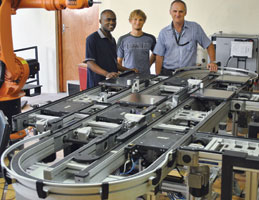
From l: Masters’ students Chibaye Mulubika, Anro le Roux and Professor Anton Basson showcase the TS2-Plus conveyor system.
“The distinguishing feature of RAS is that the systems are aimed at producing a wide variety of products, in contrast to the more conventional approach where an assembly system is designed to produce large volumes of nearly identical products,” explains Professor Basson.
Most of South Africa’s manufacturing exports are aimed at niche markets, implying that relatively small volumes of high variety products are produced. Manual assembly is readily adaptable to product variety, but the quality requirements for exported goods are often difficult to meet with manual labour alone. In order to best meet these demands, a good combination of manual and automated production is required for the South African manufacturing industry.
A key subsystem of the laboratory RAS is the Bosch Rexroth TS2-Plus pallet-based conveyor system, provided by Tectra Automation. Its ability to direct the movement of pallets along various paths, as directed by product changes, is essential for the system’s reconfigurable assembly ability. Its modularity also facilitates future changes to the layout to accommodate new stations or changed production requirements.
Apart from conveying different types of media, including polyamide belts, toothed belts, flat top chains and accumulation roller chains, the TS2-Plus also provides an abundance of specific units including curves, transverse conveyors, position and drive units. In addition, the time and effort spent on planning and designing can also be reduced to a minimum thanks to the predefined macro modules.
Other benefits of the TS2-Plus include:
* A high maximum load of up to 100 kg per workpiece pallet.
* Workpiece pallet sizes ranging from 160 x 160 mm to 1040 x 800 mm.
* Four types of conveying media, which can be combined together to meet the needs of the assembly process.
Another challenge taken on by Anro le Roux, a Masters student in Mechanical Engineering, is to develop control strategies that will enhance the re-configurability of the ‘transport system’, which mainly comprises the TS2-Plus conveyor system.
“One aspect of the challenge is the optimal use of the read/write capabilities of the Bosch Rexroth RFID system to increase robustness, decrease the ramp-up time after reconfiguration, and improve diagnostic information for the cell control system,” says Professor Basson.
MADRG and Tectra Automation are currently planning a follow-up project to take the technology from the laboratory into industry.
Magma X100 delivers AMB systems for wide range of industrial machinery
Electrical switching & drive systems & components
SpinDrive launches Magma X100 controller, bringing active magnetic bearing technology to a new generation of industrial applications. The Magma X100 expands SpinDrive’s oil-free, frictionless AMB technology to applications below 150 kW, unlocking new addressable markets.
Read more...Why lubrication fails in mining and what to do about it
Editor's Choice Electrical switching & drive systems & components
Lubrication Engineers explains the recurring failure points behind mining lubrication problems and how the right product, storage and application practices can improve equipment reliability.
Read more...Echain protects cables in cleanrooms igus
Electrical switching & drive systems & components
Advanced polymer manufacturer igus has developed a new cleanroom energy chain with an innovative guide system that allows for abrasion-resistant travel over distances of up to 30 metres.
Read more...PowerFlex drives cut energy use by up to 30% amid rising costs
Electrical switching & drive systems & components
Rockwell Automation’s PowerFlex 755TS variable frequency drives are delivering energy reductions of 10 to 30% in Africa’s industrial operations, with adaptive control and predictive maintenance features that cut downtime by up to 50%.
Read more...Next-generation oil-free motor systems with active magnetic bearings
Electrical switching & drive systems & components
WEG and SpinDrive are collaborating to integrate SpinDrive’s AMBs and built-in IoT condition monitoring into WEG’s market-leading electric motor offering, creating an oil-free, maintenance-free drive solution.
Read more...Direct drive with integrated control Vepac Electronics
Electrical switching & drive systems & components
The PSD 40 direct drive is a mechatronic system with integrated control, bus interface and absolute measuring system, with no battery required.
Read more...AI-powered on-premises analytics for industrial drives Siemens South Africa
Electrical switching & drive systems & components
Siemens is introducing a new on-premises analytics solution for industrial drive systems. The software enables users to evaluate drive data entirely within their own infrastructure and meet stringent data-sovereignty requirements.
Read more...Hydrostatic machine base for ultra-precision grinding centre
Electrical switching & drive systems & components
Hyprostatik Schönfeld has developed a high-precision hydrostatic machine base for a new ultra-precision grinding centre for Optotech. The machine platform enables a previously unattainable combination of dimensional accuracy, dynamics and surface quality in the ultra-precision grinding of optical surfaces.
While every effort has been made to ensure the accuracy of the information contained herein, the publisher and its agents cannot be held responsible for any errors contained, or any loss incurred as a result. Articles published do not necessarily reflect the views of the publishers. The editor reserves the right to alter or cut copy. Articles submitted are deemed to have been cleared for publication. Advertisements and company contact details are published as provided by the advertiser. Technews Publishing (Pty) Ltd cannot be held responsible for the accuracy or veracity of supplied material.










 printer friendly version