


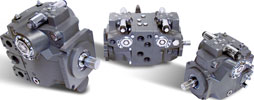
With Tier 4 emission regulation scheduled for enforcement in the US from 2011 to 2014, two hydrostatic pumps from Sauer-Danfoss will help meet the stringent new emission requirements.
Sauer-Danfoss’s original H1 closed circuit variable displacement axial piston pumps enjoyed almost instant popularity on their initial launch in 2005. The successful 147/165 cc single and 45/53 cc integral tandem pumps were later supplemented with the single pumps. This was an important step towards satisfying growing OEM demand for the range. It also gave Sauer-Danfoss the opportunity to complete its range of more application-specific control system options.
Support for Tier 4
The release of the H1 45/53 cc and 78 cc pumps created great interest as OEMs turned their attention to the Tier 4 emission regulation, scheduled for enforcement in the US from 2011 to 2014. The regulation, which will also set the direction for Europe and Asia-Pacific, brings a further drastic reduction in acceptable exhaust emissions in the wake of Tier 3. This latter Tier was completely phased in during 2008. Off-road diesel engines, such as those used in construction, agricultural and industrial equipment, are the target.
The H1 45/53 cm and 78 cc pumps have all the strong characteristics of the first family members. A compact design and high power density, with an integral electro-hydraulic servo piston assembly that controls the speed and direction of hydraulic flow, are standard. These are key features for OEMs in making the necessary changes in vehicle architecture and control algorithms to meet the Tier 4 requirement.
Ron Sheehan, business unit manager at Sauer-Danfoss, explains the advantages, “H1 offers better horsepower management via improved total pump efficiency, in addition to helping control vehicle maintenance and operating costs. Better efficiency means you can use smaller engines on some machines while reducing machine heat load and increasing power to the ground.
“Because tomorrow’s electronically controlled engines are going to need electronically controlled pumps, H1 is fully PLUS+1 compliant to interface seamlessly with our electronic machine control performance.”
Control options
There are two control options. The first is a three-position control for the vibratory drives of non-propel applications, typically used by the road construction industry. The second is a non-feedback proportional control for propel applications such as tele-handlers. This gives OEMs a comprehensive range to choose from.
H1 hydrostatics are ideal for manufacturers developing high and medium power mobile machinery that requires steady, instant propulsion and precise control in demanding work environments.
New variable motors released
Sauer-Danfoss also offers the range of H1B bent axis variable motors to complement the H1 generation of hydrostatics. The proven and optimised 9 piston rotating group along with the single piece housing is designed for quality and reliability. The expanded functionality of the H1B motor provides zero degree capability in conjunction with the unchanged 32° feature. Sheehan further comments that the motor has greater total efficiency with minimised losses at improved high flow conditions.
For more information contact Ron Sheehan, Sauer-Danfoss, +27 (0)11 803 8390, [email protected], www.sauer-danfoss.com






© Technews Publishing (Pty) Ltd | All Rights Reserved

 printer friendly version