Hydraulic hose quality survey
1st Quarter 2011
Hydraulic systems & components
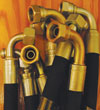
An independent snap survey on the quality and service associated with hydraulic hose assemblies supplied over trade counters was recently conducted.
This was based on one single, basic type of hydraulic hose assembly. Twelve different companies were approached. The survey covered the complete customer experience and included service factors such as time taken to provide the hose assembly, professionalism, promptness and effort. The price of the assembly was also taken into account.
Following this the assemblies were inspected to see whether the hoses and fittings were properly assembled and marked. In addition they were subjected to a static pressure test at maximum working pressure, twice maximum working pressure and three times maximum working pressure. These inspections were carried out by Genflex, whose own hose was tested in the same manner.
The outcome of the quality evaluation was that after increasing the pressure, 44% of the hoses which were assessed returned a leak between collar and fitting at pressures below the safety limit. In addition 22% turned in a poor visual report on inspection. None of the hoses were capped to protect them from dust and 66% were not marked with hose and company details.
David Michelle, director of Genflex Hydraulics, said, “These results should have been much better. The Fluid Power Association has gone to great lengths to provide training and guidance for hydraulic hose companies and their staff. This shows that training of the assembler who manufactures hydraulic hose assemblies is urgently needed.”
Another interesting finding of the survey was that a large price discrepancy was noted, with the most expensive assembly being 237% more than the cheapest.
With respect to service, 64% of the companies scored greater than 80% on service criteria and 91% scored greater than 70%. One company scored below 50% and no company achieved 100%. In addition 25% of the companies approached did not have the required hose and fittings in stock despite the fact that they were of a simple and common type.
David Michelle continued, “Principal companies do not make hydraulic hose assemblies. The actual assembly of hydraulic hose is done largely by staff at outlets, who tend to move from one company to another.
“This report is not pointing a finger at any specific hydraulic hose company. It is written in good faith and the intention is to encourage all outlets to look closely at their manufacturing processes. They are also urged to use every means at their disposal to upgrade their training programmes and improve the quality of the assemblies that are sold through their trade counters,” he said.
The facts and figures on which this survey is based are in the possession of the editor.
For more information contact Bruce Garner, Genflex Hydraulics, +27 (0)11 900 3235, [email protected], www.genflex.co.za
Further reading:
From question to innovation
Axiom Hydraulics
Hydraulic systems & components
A field question sparked the journey toward a safer solution. When a simple inquiry, “What about the Hilux?”, posed a challenge, it ignited the innovative spirit at Axiom Hydraulics.
Read more...
The ultimate asset protection
CT Hydraulics (Nqoba)
Hydraulic systems & components
Prioritising the prevention of hydraulic fluid contamination is the single most effective way to eliminate the presence of microscopic debris introduced during hose assembly, repairs, or maintenance.
Read more...
Axial piston pump series for next-gen hydraulic applications
Hydraulic systems & components
Moog has launched its new AXP Axial Piston Pump Series, a next-generation hydraulic solution engineered to deliver optimal performance, reliability and cost efficiency for industrial applications.
Read more...
Identifying signs of hydraulic cylinder wear and tear
CT Hydraulics (Nqoba)
Hydraulic systems & components
Recognising the early warning signs of hydraulic cylinder degradation is crucial for preventing costly downtime, ensuring operator safety and maximising the lifespan of your hydraulic systems.
Read more...
How laser cladding delivers 33% more life and maximum ROI in hydraulic cylinders
Hydraulic systems & components
By utilising advanced laser cladding, Honingcraft can help clients achieve a 33% longer life from their components, ensuring they secure the maximum return on their investment.
Read more...
Filtration as a reliability driver in motion control systems
Parker Hannifin - Sales Company South Africa
Hydraulic systems & components
This article highlights the importance of filtration in motion control systems, how contamination affects performance, and what fleet managers, operators and maintenance teams in southern Africa can do to reduce downtime, avoidable wear and costly repairs, aided by Baldwin Filters.
Read more...
Tuning into what your system is telling you
Hydrasales
Hydraulic systems & components
Hydraulic presses can run like clockwork, but often it’s the things you don’t see, or hear, that carry the most telling signs of irregular system health.
Read more...
A guide to common hydraulic system contaminants
CT Hydraulics (Nqoba)
Editor's Choice Hydraulic systems & components
Every engineer, machine designer and maintenance professional understands that the heart of any reliable hydraulic system is its fluid. But the moment that fluid is compromised, your system’s life expectancy and your peace of mind drop dramatically.
Read more...
Making lines safer with smarter connection
Hydrasales
Hydraulic systems & components
Imagine connecting multiple hydraulic lines or a combination of hydraulic, electrical and grease lines with one single, confident movement. That’s the everyday convenience operators get from Faster’s MultiFaster multi-coupling systems.
Read more...
Hydraulic system upgrades to boost performance and save money
CT Hydraulics (Nqoba)
Hydraulic systems & components
Those working with hydraulic or pneumatic systems know that keeping your machinery running at peak performance balances productivity and cost. As systems age, they often become less efficient, requiring more energy and more frequent repairs. The good news is that you don’t always need to invest in an entirely new machine to solve these problems.
Read more...










 printer friendly version