


Engineers from the older generation will remember the days when machine design had to be based around catalogued electromechanical actuators. Variations from standard were rare, in addition to being expensive. Fast-forward around 40 years and the modern experience is somewhat different. Today’s machine designers not only desire highly configurable and adaptable products, they expect them.
With this in mind, many leading motion technology suppliers have developed their product portfolio specifically for machine designers. Explained below are some key factors that will aid the selection of electromechanical motion products for use in the machines of today.
Stroke capacity
Among the fundamental questions to ask is: does the actuator offer various stroke lengths as standard? A product using a ball or lead-screw drive is commonly restricted to stroke lengths up to around two metres maximum for practicality. There are some actuators offering strokes to four metres, however at lengths such as these, speed is often limited due to screw whip, so the product that achieves a particular speed at one stroke will not usually achieve that speed at a longer stroke length.
Very long stroke lengths can, however, be achieved by belt drives, which perform to a similar level regardless of stroke length, but lack the precision of a screw-driven product.
A further option is linear motor-driven products, which provide performance levels that scale extremely well with increases in stroke. In addition, linear motors do not demonstrate speed restrictions at longer strokes and offer the same repeatability over the full stroke.
Scalability
With regard to scalability, machine builders should determine if the actuator is available in a number of different frame sizes or widths. Having a family of products to select from allows the project to be cost-optimised. Moreover, many multi-axis applications demand different loading for each axis.
Having multiple drive train choices in the same product is often overlooked, but the availability of screw or belt options within a given product can prove extremely useful to a machine designer. In the same form factor, designers can tailor the drive train to specific requirements, be it thrust density normally obtainable from a screw drive, or speed from a belt drive. The ability to bounce between the two without having to rethink the machine’s layout can be highly beneficial.
Modularity and performance
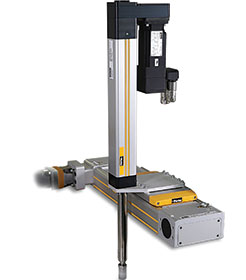
It is a common requirement for electromechanical actuators to be connected to other actuators or mechanical devices. The ability to combine linear actuators into XY, XZ, or XYZ assemblies quickly and effortlessly is vital. As a result, most modern electromechanical products can be bolted together like building blocks, without the use of transition plates for XY systems (plates are often unavoidable for the Z or vertical axes to maintain stability).
A further factor here is performance-to-size ratios, which should be considered carefully. Using a product that is highly condensed leaves more space for machine designers to include end effectors and tooling. For this reason, metrics such as thrust or rated load per height-by-width become important.
Selectable resolutions and encoder types
To retain good servo control, an actuator should have five to ten times more resolution available than the repeatability of motion required. With this in mind, having multiple options is the optimum solution as high resolution encoders can be quite costly.
Being able to adjust the resolution is also important. Some of the latest encoder products can vary their resolution through a relatively simple hardware change. A further approach is to deploy analog feedback devices and compatible servo drives. In using analog feedback signatures (typically 1 V peak-to-peak), two analog signals are passed from the encoder to the drive, 90° out of phase with one another. Equivalent resolution is established within the drive, and is dependent upon the pitch of the linear scale and resolution of the drive’s analog input.
Flexible encoders
As well as flexible resolution, the availability of flexible encoder technologies is another major benefit. Optical encoders with glass scales have been a popular choice for many years, but today there are many alternative technologies that provide competitive resolutions and costs.
For example, in applications that do not require especially high levels of precision, magnetic encoder technology is a cost-effective option, while applications that do require high precision but not long stroke lengths benefit from the very high resolutions of capacitive encoders. Inductive encoders are often popular for applications directly exposed to heavy contamination, such as coolant from a machine tool. Applications which require constant positional information regardless of an axis being homed will require an absolute feedback source.
With regard to communications, until recently, most encoder protocols were based on embedded propriety signals, which meant that designers had to use a limited list of manufacturers. Today, open standard protocols such as the single cable Hiperface DSL solution allow design engineers to use a variety of products and even reduce installation and cabling efforts.
Digital design
In cutting-edge design software, finite element analysis (FEA) can be used to understand not only the deflection characteristics, but also the thermal or magnetic variations within the product. Naturally, these simulations cannot give results with 100% certainty as they are only as good as the algorithms and assumptions that are used, but modern machine design is starting to leverage these digital design methodologies more heavily to expedite development.
Metrology test data
Test data from metrology can be used to take ballscrew backlash into account, and improve overall system accuracy. For applications with very specific requirements, these tests can be performed to mirror the actual application characteristics. Cleanroom applications are a good example as there are many characteristics, such as speed, acceleration, orientation and air flow, which can greatly impact product performance. Selecting products from a design partner that understands the mission-critical aspects of the application and tests will prove particularly advantageous.
Summary
Today, the demand for faster turnaround time on machines has become critical. The same design engineer who might have allowed for a machine to be developed in several months, now expects it in weeks. Key to the machine-building race is selecting the right product from a manufacturer that understands the daily design hurdles and has systems in place that allow for rapid machine development.
Factors such as breadth of product, range of options, modularity and product test data should be taken into account when designing the machines of today. This strategy will enhance the machine builder’s ability to respond to customer needs, and provide faster ROI.
For more information contact Lisa de Beer, Parker Hannifin SA, +27 11 961 0700, [email protected], www.parker.com/za
| Tel: | +27 11 961 0700 |
| Fax: | +27 11 392 7213 |
| Email: | [email protected] |
| www: | www.parker.com/za |
| Articles: | More information and articles about Parker Hannifin - Sales Company South Africa |






© Technews Publishing (Pty) Ltd | All Rights Reserved

 printer friendly version