



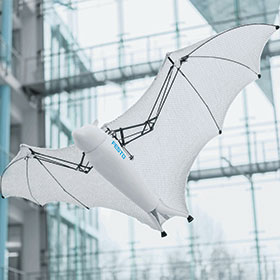
The dream of flying is one of the oldest known to humankind. In Festo’s Bionic Learning Network, flying is a recurring theme. In association with universities, institutes and development companies, Festo has for years been developing research platforms where the basic technical principles are derived from nature.
For the BionicFlyingFox, the developers took a close look at the flying fox’s special characteristics and implemented them in an ultra-lightweight flying object. With a wingspan of 228 cm and a body length of 87 cm, it weighs just 580 g. The flying fox belongs to the order Chiroptera – the only mammals that can fly. A particular characteristic is their fine elastic flying membrane. This consists of an epidermis and dermis and stretches from the extended metacarpal and finger bones down to the foot joints. In flight, the animals control the curvature of the flying membrane with their fingers, allowing them to move aerodynamically through the air. The wing kinematics of the BionicFlyingFox are also divided into primaries and secondaries and covered with an elastic membrane. As with the biological model, all the articulation points are on one plane, so the it can control and fold its wings together individually.
The BionicFlyingFox communicates with a motion tracking system that constantly records its position, plans the flight paths and delivers the necessary control commands. An important part of the motion tracking system is two infrared cameras, which rest on a pan-tilt unit. They detect the flying fox by means of four active infrared markers attached to the legs and wing tips. The images from the cameras go to a central master computer. This evaluates the data and externally coordinates the flight like an air traffic controller. The wing movements required to ideally implement the intended courses are calculated by the flying fox itself with the help of its onboard electronics and complex behaviour patterns. It gets the control algorithms from the master computer, where they are automatically learnt and constantly improved. The BionicFlyingFox is thus able to optimise its behaviour during the flights and follow the specified courses more precisely with each circuit flown.
The primaries and secondaries can be activated in any state so that the wings move harmoniously. The primary is coupled to the secondary and follows the latter due to forced kinematics, whereby dead centres in the movement are prevented. A nine gram lightweight brushless DC motor in the body of the flying fox drives these flying kinematics by means of a gear ratio. The folding mechanism on the wings can be individually and infinitely adjusted using two small linear drives.
The BionicFlyingFox can also manage a tight flight radius despite its large wingspan. This is made possible by its ingenious kinematics. It works according to the scissor principle. The primary folds in during the upswing and spreads back out for the powerful downswing. This effect is achieved by a sophisticated mechanism: the angular and rack-and-pinion gear units implement the wing movement synchronously with the help of forced kinematics. Inertial sensors on the on-board electronics monitor the flying manoeuvres and correct with corresponding control signals if needed. Besides the ingenious kinematics, the flying fox also owes its agility to its lightweight design. The same applies in engineering as in nature: the less weight there is to move, the lower the energy consumption.
The artificial flying fox provides important findings for industrial automation. In the factory of the future, intelligence from the central control system will be divided into subsystems and components. Even single workpieces will become intelligent and know what product they are supposed to be made into. They will accordingly be able to communicate with the machines and tell them how they must be processed.
In the case of the BionicFlyingFox, the intelligence is also decentralised: the master computer specifies the flight paths and control commands. During the flight, it compares its calculated intended courses with the actual ones and adjusts these with increasing efficiency using machine learning. It detects how it must control the wings and legs in order to implement the commands from the master computer in an optimal manner.
With the artificial flying fox, Festo has now technically implemented the unique kinematics of Chiroptera and decrypted the last flying behaviour from the animal world within the framework of the Bionic Learning Network.
For more information contact Kershia Beharie, Festo, +27 11 971 5509, [email protected], www.festo.co.za
| Tel: | 08600 FESTO (33786) |
| Fax: | +27 11 974 2157 |
| Email: | [email protected] |
| www: | www.festo.co.za |
| Articles: | More information and articles about Festo |






© Technews Publishing (Pty) Ltd | All Rights Reserved

 printer friendly version