


New High-Slip Braking software, developed by Yaskawa Electric America for its advanced AC drives, produces drastic reductions in braking time while eliminating the need for and expense of external braking resistors. The software is specifically designed for AC drive applications that benefit from fast stops, including emergency stops. It is suitable for high-inertia rotating loads such as centrifuges, mixers, blowers, presses and laundry equipment.
Variable speed drives (VSDs) have always included cost-effective methods for providing fast, reliable braking. DC injection and dynamic braking have been used in VSDs for years.
DC injection braking involves applying DC voltage to the AC induction motor's stator winding. This generates an opposing magnetic field that slows the motor down. The disadvantage of this method is that maximum braking torque is limited (approximately 66% of full motor torque) and motor heating can be excessive. Dynamic braking uses a resistor bank to dissipate the heat. The motor being decelerated operates as a generator, which feeds energy into the drive's DC bus and the braking resistor.
Dynamic braking allows very quick braking times because brake torque can be as high as 150% of full load motor torque. The disadvantage is the cost of the resistor and braking chopper transistor needed. Additionally, the resistor must be caged and vented properly to prevent fires.
High-inertia loads
High-slip braking (HSB) for high-inertia loads can provide braking torque in excess of 100% full load motor torque. Unique Yaskawa software, part of the drive control scheme, controls the deceleration to make the motor operate as a very inefficient induction generator. The advantage of this method is that no additional cost or parts are required to produce full braking torque.
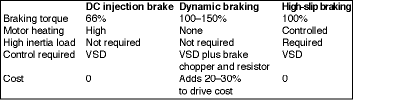
HSB is achieved by modifying the Volts/Hz pattern during deceleration to maintain enough motor slip so that load energy is absorbed in the rotor bars, stator windings and stator core of the motor. Current level is controlled to avoid excessive motor heating. Deceleration time is directly related to the actual load torque and inertia.
Impressive on-site test results
On-site application tests have provided some remarkable results. Large industrial washing machines that accept 300 kg of dry weight linen have been able to stop from extract (spin) speeds in two minutes - without noticeable motor heating. This same machine would take 25-30 minutes to coast to stop. However, these machines normally utilise dynamic braking to maintain reasonable cycle times. Dynamic braking provided a stopping time of 1,2 minutes on these machines at a cost of 30% of the total control equipment. Laundries are notorious for having lint problems and, because of the heat generated by the DB resistors; this lint can become a real fire hazard. These problems are eliminated with HSB with only minor change in deceleration time and huge cost savings.
Other examples
Another application involved a centrifuge that separates butterfat from whole milk in a dairy. Normally the centrifuge coasts to stop in 20-25 minutes. HSB was able to stop the units in 3,5 minutes. High inertia fans are another application that can benefit from HSB providing an effective no-cost method for improving stopping times.
Cost-effective stopping method
HSB is not the answer for all applications. However, it is a cost-effective method for stopping high-inertia loads, in the order of five times the motor inertia. High-inertia fans, centrifuges, laundry equipment and punch presses all offer excellent opportunities to apply HSB-equipped variable frequency drives. HSB is a standard feature on Yaskawa's new E7 HVAC drive and F7 Vector and G7 Flux Vector drives.






© Technews Publishing (Pty) Ltd | All Rights Reserved

 printer friendly version