



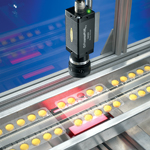
Unlike a photoelectric sensor, which uses a single photoelectric cell, a vision sensor has many photoelectric cells that capture an entire scene. The amount of detail the image shows - the resolution, expressed as the pixel count - depends on how many photoelectric cells the sensor has. For example, some vision sensors from Banner Engineering can capture 1,3 million pixels. As a result, the sensor 'sees' with great clarity, whether centimetres or metres away from the object.
After capturing the image, the device that processes the image, either the vision sensor itself or a separate PC, analyses the image by comparing it to the reference image stored in its memory. So, for example, if the operator sets up the device to recognise a blister pack with 10 undamaged tablets, the device knows to reject a pack that has only nine tablets or a broken tablet. Furthermore, it can make that determination regardless of where the packet is located within the camera's field of view. And it can inspect asymmetrical objects no matter how they are rotated within a full 360° range. Vision sensors with a remote TEACH feature make it possible to change inspections remotely.
Vision technology has been around for about 40 years, but until recently was available only in complex, expensive, multicomponent systems. Vision systems require one or more cameras, custom software, and a PC to perform the image processing. They usually necessitate hiring an outside vision consultant to design and integrate the system. In addition, because vision systems are application-specific, they cannot easily be modified for other inspections. Finally, they are difficult to support, usually requiring additional outside help. PC-based vision systems start at about R70 000 but can cost several times that amount.
Vision systems have their place, but the advent of less costly, less complicated vision sensors is shrinking the number of applications that warrant vision systems. Vision sensors, sometimes called smart cameras, do not require a PC to run an inspection, although some can be connected to one for Ethernet or bus networks.
Vision sensors are smaller and less expensive than vision systems, starting at about R7000 for a basic one and about R18 000 for a full-featured model. Consequently, manufacturers can use vision sensors - and more of them - in applications for which a vision system cannot be justified. As a result, vision sensors can solve more inspection challenges.
The lower cost and improved performance of vision sensors have led machine designers and process engineers from a wide range of industries to incorporate vision sensors in applications that once relied on humans or multiple photoelectric sensors, or were not inspected at all.
Industrial applications of vision sensors include verification, gauging and measuring, orientation, flaw detection, and sorting. Here are just a few examples:
* On a filling line in a tablet manufacturing plant, ensure that a complete desiccant package is dropped into the bottle before it is capped.
* Verify the dimensions of a medical component.
* Inspect the date/lot code and data matrix bar code on bottles of a prescription medication.
* On a packaging line, make sure the correct label is attached and is in the correct location.
* Inspect cannulas at high speeds to verify that each cannula is straight and the correct amount of epoxy attaches it to the syringe barrel.
It is an exciting time for automated machine sensing. Technologies that once required a high level of expertise are now simple to use and affordable. Ongoing development will produce sensors that are more sophisticated but still cost-effective and used in more applications than before. The challenge now is to make machine designers aware of the innovations in photoelectric sensors, advances in ultrasonic sensors, and migration to vision sensors, so they can benefit from these booming technologies.
About Banner
Banner Engineering is one of the world's leading manufacturers of photoelectric sensors, vision and ultrasonic sensors, fibre-optic assemblies, electronic machine guarding systems and precision measurement systems. Banner is represented in South Africa by RET Automation Controls.
About Jeff Schmitz
Jeff is corporate business manager for Vision products at Banner Engineering. See www.bannerengineering.com/training for more about vision sensing and applications.
| Tel: | +27 11 453 2468 |
| Email: | [email protected] |
| www: | www.turckbanner.co.za |
| Articles: | More information and articles about Turck Banner Southern Africa |






© Technews Publishing (Pty) Ltd | All Rights Reserved

 printer friendly version