



Other technologies


Repeatable cylinder decompression the 'balanced' way

Fourth Quarter 2006 Other technologies

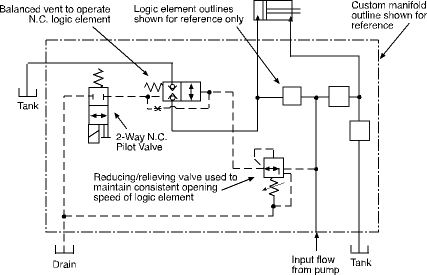
In a cylinder circuit, when using logic elements to emulate a four-way directional valve function, minimising decompression shock when changing from extend to retract can be a challenge. The larger the volume of oil being compressed (ie, the larger the cylinder bore and/or stroke), the larger the 'shock' potential due to the stored hydraulic energy.

Since this stored energy in the cap end of a cylinder is a 'fact of life' (and do not forget that the machine frame and product being compressed can also add to the total stored energy), the goal is to release this energy in a controlled and consistent manner, in the shortest time that will achieve an 'acceptable' decompression rate (which is usually determined subjectively). The use of dedicated decompression circuit components (ie, staged pilot ratio check valves, orifices, solenoid valves controlled using electrical time delay logic) can be expensive, have questionable reliability, are not always consistent, and consume excess cycle time.

A simplified solution is by using Sun DK*R Balanced Logic Elements with a 2-way DAAL-*CN pilot valve and a Sun PRDB pressure reducer/reliever, the result is a zero leak, reliable, consistent, uncomplicated, and cost effective cap-end-to-tank, normally closed logic element. (A DO*R cartridge can be used in place of the DK*R if a normally open function is desired. Either cartridge can also include Sun's T-8A cavity, ie, DK*R-8 and DO*R-8, to accommodate the pilot control function as an integral unit.) Since this product is 'balanced', operating pressures on the work ports have no effect on the opening speed of the valve. (A typical 'poppet style' logic element exposes more and more area as the poppet moves to the open position, with the attendant increase in opening force.) So, by adjusting the pilot pressure via the reducer, an acceptable and repeatable opening time can be easily set. This approach has proved to be an acceptable solution in minimising decompression shock in the shortest time with consistent results. (Using the newer DAAL-SCN 'soft shift' 2-way as the pilot valve, can further enhance tuning for shock reduction.)

NOTE: Using Series 4 size cartridges, flows up to 80 gpm (320 L/min) with a nominal 100 psi (689 kPa) pressure drop can be achieved. However, when even larger flows are required, two, three and four DKJR logic elements have been successfully applied in parallel and have accommodated flows up to 320 gpm (1280 l/min). (With multiple elements, an external pilot valve sized for the number of cartridges involved, would be required in lieu of integral solenoid pilots in each element.) Also, keep in mind that a balanced logic element can be used as a standalone valve in a machine with a common spool valve circuit if that machine is experiencing excessive decompression shock.


Credit(s)


Share this article:
Share via emailShare via LinkedInPrint this page

Further reading:

Oil monitoring solution drives performance gains for paper mill
SKF South Africa Other technologies
By integrating real-time monitoring with precise flow control, SKF’s Flowline oil monitor meters have significantly improved the flow rate control and performance of oil circulation lubrication systems installed on a paper mill.

Read more...
The Konecranes portal, a benchmark in data supply
Other technologies
The newly launched Konecranes Portal takes online communications to the next level through its single point of access to its digital customer platforms

Read more...
Ultra-compact industrial PCs exploit advances in CPU technology
Beckhoff Automation Other technologies
Beckhoff’s C60xx scalable series of ultra-compact industrial PCs combines high computing power in an extremely compact format with a wide range of options for installation in the control cabinet.

Read more...
Anti-wear additives – the metal guardians in your oil
Other technologies
Anti-wear additives are used to protect against wear and the loss of metal surfaces during mixed-film and boundary-film lubrication.

Read more...
OMRON simplifies safety verification for SA manufacturers
Omron Electronics Other technologies
OMRON’s NX Safety platform, Online Safety Functional Test Verification is a feature built into the Sysmac Studio engineering environment. This intuitive tool allows safety verification to be carried out digitally, with step-by-step guidance and full traceability, all from a single workstation.

Read more...
Condition monitoring in hazardous areas
SKF South Africa Other technologies
SKF is further strengthening its condition monitoring offer portfolio by a newly developed hazardous area version of its Microlog Analyzer dBX portable vibration analyser.

Read more...
Why AI will never truly understand machines
Other technologies
Cutting-edge technology and solutions powered by AI are embraced by specialist condition monitoring company, WearCheck, where the extreme accuracy of data used to assess and diagnose machine health is paramount.

Read more...
Robotic filling systems for the pharmaceutical industry
Horne Technologies Other technologies
Pharma Integration, a leading pharmaceutical manufacturer, aims to replace traditional mechanical filling lines with compact, fully automated systems that are 100% robot-driven using machines known as Azzurra. Their integrated Faulhaber drives play a crucial role in the fill-finish process, ensuring the highest precision and safety across multiple production steps.

Read more...
Heavy impact, smart control
Axiom Hydraulics Editor's Choice Hydraulic systems & components
Every now and then a project lands on your desk that’s equal parts heavy machinery and fine control - a tantalising mix for any engineer. A client approached Axiom Hydraulics with a project exactly like this.

Read more...
World first simulation of error-correctable quantum computers
Other technologies
Quantum computers still face a major hurdle on their pathway to practical use cases, their limited ability to correct the arising computational errors. In a world first, researchers from Chalmers University of Technology in Sweden have unveiled a method for simulating specific types of error-corrected quantum computations.

Read more...


While every effort has been made to ensure the accuracy of the information contained herein, the publisher and its agents cannot be held responsible for any errors contained, or any loss incurred as a result. Articles published do not necessarily reflect the views of the publishers. The editor reserves the right to alter or cut copy. Articles submitted are deemed to have been cleared for publication. Advertisements and company contact details are published as provided by the advertiser. Technews Publishing (Pty) Ltd cannot be held responsible for the accuracy or veracity of supplied material.


© Technews Publishing (Pty) Ltd | All Rights Reserved