


Editor's Choice


A linear induction motor with a twist

1st Quarter 2016 Editor's Choice Electrical switching & drive systems & components

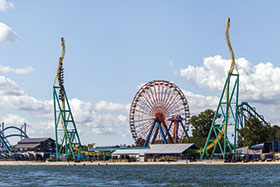
Just steps from the beach you can launch yourself into a spiralling scream-fest. This is not just a coaster, it’s a double-twisting impulse coaster – one of the tallest and fastest in the world. You’ll be rocked, rolled and launched into two 450° spirals at each end of the tracks. You will be twisted – wickedly. This is the Wicked Twister at Cedar Fair in Sandusky, Ohio, which operates using state-of-the-art linear induction motors (LIMs) to propel riders up to a speed of 115 km/h. Motion Control’s editor, Kim Roberts, spoke to Monty Jasper, corporate vice president for safety and engineering, about the engineering behind the Wicked Twister and its counterpart, the Maverick.

Designed by Intamin, the Wicked Twister consists of two 66 metre tall spikes with 450 degree vertical twists. Between the towers, a horizontal track section incorporates the load and unload area as well as the LIM propulsion system.

Unlike most roller coasters the LIM launches horizontally and thrill seekers are treated to a powerful combination of five launches out of the station, three forwards and twice backwards, while reaching the apex of each vertical tower as it picks up velocity up to 115 km/h from the LIM propulsion system.

Jasper explains that each LIM is like the armature in a normal motor, with wire wrapped around a coil. These are positioned in pairs with a gap of 10 mm between the two blocks. “We pass a 3 mm aluminium fin between them,” he says. “Putting power through the coils results in a magnetic field on either side. Running the fin through them makes the fin want to jump out, thus propelling the train. The fin is on the top of the track and the train is hung from the bottom of the track with people’s legs dangling – there are no floors – while on top, the roller coaster is hanging from its wheels with the aluminium fins passing between the LIMs, which run from the station all down the track. They are powered in sequence and push the train down the track.

“It’s an eerie feeling,” says Jasper, “There is no mechanical contact yet you can feel the force of the magnetic field.” He adds that Cedar Point chose LIMs for Wicked Twister because horizontal launch options are limited and this electrical option is extremely innovative. However, LIMs come with some unique requirements and Cedar Point had to install a dedicated 34 000 V power line to power the coaster. “We’re using such a massive jolt of electricity to operate Wicked Twister that it would be enough to power 550 average-sized homes,” he says.

On the other side of the park is the Maverick, which operates with linear synchronous motors (LSMs). Maverick definitely delivers thrills. It has two cars which go out of the station up a shaft – there is no lift chain. The first hill is set at a 95° angle – that’s 5° past vertical – meaning you feel like you’re going to nosedive off the tracks. It twists and turns, switching back on itself in the first ever twisted horseshoe roll. Just when you think the ride’s over, Maverick hits 112 km/h in three seconds.

Here there is no aluminium fin, instead an energised magnet passes between the coils of two magnets on each side and the repulsion propels the train forward. There are hundreds of these magnetic fields along the track and they are energised as the train approaches and turned off as it passes.

A big advantage of using LIMs and LSMs is that maintenance is reduced. “There are no metal-to-metal contacts, no wear points, no chain moving around, no lubrication, no worn out pieces and parts, because nothing is touching,” Jasper says. “The only things touching are the wheels on the track.”

One difference between the two is that the LIMS are all air cooled, you can hear the fans blowing, while the Maverick is cooled with glycol. “It’s stealthy quiet,” Jasper said. “It’s awe-inspiring to stand there and not hear a sound as it goes up the lift. It’s almost ghostly.” There are also differences in torque and speed. The LIMS is designed for fast lift-off to reach maximum velocity quickly while the LSM allows you to get the height with more power. “This is a great ride experience,“ concludes Jasper. “It feels like flying and it’s very cool.”

For more information visit http://tinyurl.com/jpuceq7


Share this article:
Share via emailShare via LinkedInPrint this page

Further reading:

A technological leap with the proportional valve terminal
Festo South Africa Editor's Choice
Festo continually makes bold technological leaps to keep pace with global advancements. Controlled Pneumatics is redefining the boundaries of compressed air technology to meet the demands of today’s most advanced applications.

Read more...
PC-based control optimises robotic parts handling on plastics machinery
Beckhoff Automation Editor's Choice
NEO is a cartesian robot developed by INAUTOM Robótica in Portugal for parts removal on plastics machinery. Its aim is to increase system productivity. NAUTOM Robótica has entered into a strategic partnership with Bresimar Automação to increase the working speed of the cartesian robots using advanced control and motion solutions from Beckhoff. The result is a comprehensive, future-proof automation solution for its entire family of cartesian robots.

Read more...
Heavy impact, smart control
Axiom Hydraulics Editor's Choice Hydraulic systems & components
Every now and then a project lands on your desk that’s equal parts heavy machinery and fine control - a tantalising mix for any engineer. A client approached Axiom Hydraulics with a project exactly like this.

Read more...
Driving fluid power forward
Editor's Choice
The National Fluid Power Association is developing its latest Industrial Technology Roadmap for 2025, showing how hydraulics and pneumatics are changing to meet new industrial demands.

Read more...
World’s hottest engine
Editor's Choice Electrical switching & drive systems & components
Scientists have built the world’s smallest engine. It’s also the world’s hottest. It could provide an unparalleled understanding of the laws of thermodynamics on a small scale, and provide the foundation for a new, efficient way to compute how proteins fold.

Read more...
Reinventing the wheel
Editor's Choice Electrical switching & drive systems & components
Once a curiosity in the early automotive age, in-wheel motors are now re-emerging with real promise. From electric cars to commercial vehicles and even aircraft, they are on the verge of transforming transportation engineering.

Read more...
Redefining motion control with Festo’s vision for seamless and intelligent automation
Festo Editor's Choice Electrical switching & drive systems & components
The quest for precision, flexibility and efficiency continues to shape the future of industrial automation, and Festo, as a long-standing leader in automation technology, stands firmly at the forefront of this movement, driving innovation and setting the benchmark for excellence.

Read more...
The opportunity and impact of MEPS electric motor regulations
WEG Africa Editor's Choice Electrical switching & drive systems & components
South African companies are gearing up for the new Minimum Energy Performance Standards, part of a global trend towards energy-efficient electric motors.

Read more...
Swiss watchmaking meets hypercar power
Horne Technologies Editor's Choice
The display of Bugatti’s upcoming luxury model, Tourbillon will be something truly special. Instead of a digital version, the driver will see a genuine Swiss timepiece behind the steering wheel.

Read more...
Planetary gear units for high torque requirements
SEW-EURODRIVE Editor's Choice Electrical switching & drive systems & components
[Sponsored]Packing a compact design, along with high torque and low-speed outputs, the new SEW PPK and SEW P2.e planetary gear units from SEW-EURODRIVE offer new capabilities in continuous heavy-duty applications where space is at a premium.

Read more...


While every effort has been made to ensure the accuracy of the information contained herein, the publisher and its agents cannot be held responsible for any errors contained, or any loss incurred as a result. Articles published do not necessarily reflect the views of the publishers. The editor reserves the right to alter or cut copy. Articles submitted are deemed to have been cleared for publication. Advertisements and company contact details are published as provided by the advertiser. Technews Publishing (Pty) Ltd cannot be held responsible for the accuracy or veracity of supplied material.


© Technews Publishing (Pty) Ltd | All Rights Reserved