


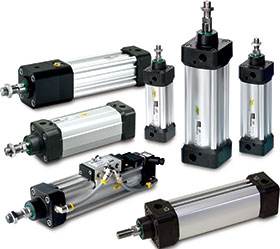
As the range of pneumatic cylinders available on the market today becomes more extensive and sophisticated, it can be challenging to maximise the return on investment (ROI) of an application. Franck Roussillon, product manager for actuators at Parker Hannifin, has some best practice advice for engineers and specifiers to shorten the payback period for investments in pneumatic cylinders.
One of the first recommendations is to avoid side-load mounting. Cylinders are designed to deliver push-pull stroke action, so side-load mounting can result in a number of performance problems, including misalignment, off-centre loads, rod deflections, imprecise tie-rod torque and long stroke action. Upon installation, the cylinder piston rod should be aligned with the mating machine component and then inspected in both the extended and retracted positions. Improper alignment can lead to excessive rod gland and cylinder bore wear, resulting in a shortened lifespan for the cylinder and lower productivity. Both of these unwanted effects extend the payback period.
Also, consider how contamination can be prevented as this will further maximise the life of the cylinder. Particulates, pipe rust, scale and thread sealant debris can all curtail the life of the seal and plug openings and damage surface finishes. Until the system is fitted with piping, keep the port plugs supplied with the cylinder in place and be sure to clean the piping thoroughly before making connections.
Moisture is another key factor to consider when trying to stop contamination, as when moisture collects in components in compressed air systems it blocks the outlet flow-through. This can be potentially damaging to the performance of the cylinder as it leads to diluted pre-lubrication grease, contaminated airline lubricants, a damaged barrel or rod finish and the potential to freeze in cold weather.
To avoid this, consider using stainless steel cylinders, which feature a smooth, hygienic exterior design. These are particularly useful for food industry applications. In addition, the end covers have no recesses that can collect unwanted contaminants or bacteria, while the scraper rings, piston rod bearings and seals are made from self-lubricating materials to allow for regular washing and degreasing of the piston rod.
To further maximise ROI it is also important to pay close attention to both the wiper seals specified and the cushioning that is needed. The end application drives the selection of wiper seals. Poor selection of seals can cause degradation, leading to the ingress of particles and dirt and the risk of cylinder failure; therefore it is imperative that fit for purpose choices are made to ensure maximum lifetime and guarantee productivity.
Cushioning is directly linked to the lifetime of a cylinder. Cushioning is required to decelerate a cylinder’s piston before it strikes the end plate. Reducing the piston velocity lowers the stress on cylinder components, increasing the lifespan and ROI. Whilst cylinders that feature automatic adjustment exist, a best practice recommendation is to use manual variants to achieve optimal cushioning as this allows the weight of the workpiece to be matched to the dynamics of the movement.
A final consideration for preventing contamination is to watch out for air compressor lubrication oil carryover or synthetic oils which are typically incompatible with airline components. Such oils can swell the seal and plug openings. Instead use oil-compatible seals.
It is well documented that cylinders operating at high or fast cycle rates will typically generate significant shock loads at end of stroke. Furthermore, the heat generated by the system can exceed the component’s temperature limits and affect the lubrication. With this in mind, consider selecting a pre-lubricated or air-cushioned cylinder. Other options include adding a shock absorber or lowering system pressure via a regulator on the return (non-working) side of the cycle. Finally, adding flow control to the cylinder can also help, as long as high speed is not required.
Running cylinders over their capacity causes high levels of stress and unwanted friction to seals, resulting in broken rod ends and disintegrated actuators. In addition, if the system contains speed control or energy-absorbing devices, then pressure spikes can double or triple normal system pressures. Engineers should make sure rod accessories are shouldered firmly by threading all the way down or by using spacers or shims. Alternatively, consider increasing the rod thread size or using a studded rod end.
There are plenty of best practice procedures that can help plant engineers and machine builders maximise return on their investment in pneumatic cylinders; and most only require minimal time and effort, with any subsequent investments within reach of most budgets.
For more information contact Lisa de Beer, Parker Hannifin SA, +27 (0)11 961 0700, [email protected], www.parker.com/za
| Tel: | +27 11 961 0700 |
| Fax: | +27 11 392 7213 |
| Email: | [email protected] |
| www: | www.parker.com/za |
| Articles: | More information and articles about Parker Hannifin - Sales Company South Africa |






© Technews Publishing (Pty) Ltd | All Rights Reserved

 printer friendly version