


Pneumatic systems & components


Filtration in pneumatic systems

2nd Quarter 2017 Pneumatic systems & components

Pneumatic valves and cylinders are not cheap, so it makes good financial sense to protect them from premature failure. Water separators have no internal filter element, they rely on centrifugal motion. These will only collect liquids that have already condensed. They may be installed prior to a coalescing set to reduce the work load on the filter elements.
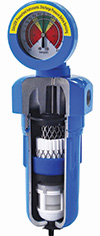
Generally the air standard for a mildly complex pneumatic system would be ISO 8573–1.4.1. All this will tell is that the particle content should be ≤ 0,10 micron, the water content should be to a dew point of 3°C and the oil content ≤0,01 mg/m³. For a coalescing filter to do this reliably and consistently is not difficult.

Coalescing filters use impact, Brownian motion and direct impact to provide this level of filtration. Solids are retained in the core of the filter, while liquid oils are deliberately allowed to permeate the outer anti re-entrainment sock to drip into the quiet zone of the filter bowl. It is normal for oils to saturate the bottom third of the filter element as this is the area where the oils coalesce from fine vapours into a concentrated liquid oil.

The hallmark of a good quality filter casing and element is that it is manufactured in high grade aluminium with a treated bowl to prevent corrosion. This has a reliable internal float drain or an external timed automatic drain and colour coded socks on the element for easy grade identification. The filter should ideally have a pleated filter media retained within an inner and outer stainless steel cage and the element life should be about one year.

A pleated filter media has at least 40% more surface area than a simple fibreglass tube or a filter that has the filter media wrapped around a central core. An added bonus would be a differential gauge that highlights when the element has reached the end of its useful life.

If you decide that oil-free air is required and that you want to use an activated carbon filter, at least two coalescing filters should precede the activated carbon filter. Activated carbon elements are designed to remove the last vapours of oil from the compressed air stream. If installed in isolation they will be overcome by the liquid oils and be saturated in days. An activated carbon filter normally will require change-out at three to four months. Unlike a coalescing filter, the oil is retained in the carbon and not released into the bowl area. To check

the status of an activated carbon filter, crack open the manual drain slowly and if liquid oils are ejected into your hand it’s time for an

element change. Activated carbon filters are not normally fitted with a differential pressure gauge.

Prices of good quality filters can vary considerably so check the primary cost and the secondary cost, often it’s the secondary element prices that will hurt your budget. Artic Driers has a very cost-effective range of coalescing and activated carbon filters at highly competitive rates.

For more information contact Allen Cockfield, Artic Driers International, +27 (0)11 420 0274, [email protected], www.articdriers.co.za


Credit(s)


Share this article:
Share via emailShare via LinkedInPrint this page

Further reading:

How to clean compressed air effectively
Pneumatic systems & components
ISO-Reliability Partners has taken another step in bringing to market highly effective solutions to combat contamination in all its forms. The locally designed and patented Air Wizard inline water trap is proudly manufactured in South Africa. It has been SABS tested for the separation of water, oily fluids, rust and solid particulates from pneumatic compressed air or gas lines.

Read more...
Compressed air piping design
Artic Driers International Editor's Choice Pneumatic systems & components
When designing a compressed air pipeline, remember that size matters. The internal size of the pipe, along with the pressure and air volume, determine the velocity of the compressed air in the pipeline.

Read more...
Top questions about pressure gauges
SA Gauge Editor's Choice Pneumatic systems & components
Some questions never go out of date, and in our industry, a few have been asked for decades. At SA Gauge, we hear them every week. Here are the ten questions we hear most often, and the practical answers that can save time, money and frustration.

Read more...
Achieving clean and dry compressed air for faultless operation
Artic Driers International Pneumatic systems & components
Compressed air is an expensive source of motive power so it makes good sense to supply clean, dry compressed air to your distribution system.

Read more...
Controlling pneumatics via IO-Link
ifm - South Africa Pneumatic systems & components
Pneumatic airboxes control cylinders or actuators using compressed air, and are found in a wide range of industrial applications.

Read more...
The role of analogue gauges in a digital world
SA Gauge Pneumatic systems & components
With so much focus on digital systems, remote monitoring and automation, it’s easy to assume that traditional analogue gauges are outdated. Yet in almost any plant, mine or processing facility, you’ll still find them in daily use. There’s a good reason for this.

Read more...
It’s full steam ahead for SKF’s sustainable leak detection solution
SKF South Africa Pneumatic systems & components
One of SKF’s key customers based in Cape Town, which depends on steam systems for its production processes, was facing costly challenges related to high energy consumption and excessive maintenance hours. SKF recommended the TKSU 10 ultrasonic leak detector as a more streamlined, user-friendly alternative.

Read more...
Dynamic compressor control system with energy savings
Pneumatic systems & components
CompAir has launched Ecoplant, a dynamic, compressed air management solution that adjusts compressor parameters in real time, offering up to 30 per cent reductions in energy costs and CO2 emissions.

Read more...
Is your compressed air system sustainable?
Artic Driers International Pneumatic systems & components
We are all aware that compressed air is an expensive source of motive power, but do we actually know what the cost is?

Read more...
Reliable, flexible and cost-effective rental compressed air
Pneumatic systems & components
More businesses are turning to Integrated Air Solutions for rented on-demand compressed air, without the burden of capital expenditure.

Read more...


While every effort has been made to ensure the accuracy of the information contained herein, the publisher and its agents cannot be held responsible for any errors contained, or any loss incurred as a result. Articles published do not necessarily reflect the views of the publishers. The editor reserves the right to alter or cut copy. Articles submitted are deemed to have been cleared for publication. Advertisements and company contact details are published as provided by the advertiser. Technews Publishing (Pty) Ltd cannot be held responsible for the accuracy or veracity of supplied material.


© Technews Publishing (Pty) Ltd | All Rights Reserved