



Omron has introduced four series of condition monitoring devices to monitor operational status in manufacturing sites for workers.
• Motor condition monitoring devices that predict a failure of three-phase induction motors.
• Power supplies with a network that can predict the service life and failures of a power supply installed in a control panel.
• Flow sensors and pressure sensors that monitor hydraulic oil and cooling water used for press machines and moulding machines.
• Smart condition monitoring amplifiers that accelerate IoT for existing analog sensors installed in facilities or machines.
This is part of Omron’s effort to complete a 100 000 IoT component line up. The monitoring devices constantly visualise facility and equipment condition that could not have been seen previously, detect status errors of facilities in advance, and maintain production lines and productivity.
They also monitor changes in power systems and circulation systems in real time. In addition they inform replacement time of parts before failures through communication networks and contribute to prevention of unexpected facility stoppages and quality abnormality of products. It is easy to capture a sign of abnormality of facilities and failures that have relied on experience and intuition of skilled workers. This reduces opportunity loss due to unexpected facility stoppages and enhances the accuracy of maintenance plans.
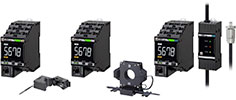
Motor condition monitoring devices
Motor condition monitoring devices detect errors caused by ageing deterioration of three-phase induction motors used for many production facilities, including conveyors, lifters and pumps. The monitoring devices detect errors by status changes in vibration, temperature, current, insulation resistors, monitor by display on the main unit or Ethernet/IP communications remotely, and solve the following issues.
• Minimise opportunity loss caused by unexpected facility stoppages
• Digitalise knowledge of skilled maintenance engineers and homogenise motor maintenance from a remote location
• Shift from periodical inspection to preventative inspection to significantly reduce inspection work.
Power supplies with network
Power supplies with network visualise necessary information to maintain and control power supplies, in addition to supplying DC electricity to devices in facilities. They can visualise when to replace themselves and information on output voltage/current, and they boost current by remote control using Ethernet/IP communications and the main unit monitor. This contributes to solving the following issues:
• Notify the power supply replacement time in advance to reduce unexpected facility stoppages due to a trouble of power supply
• Monitor the replacement time, total run time, voltage and current of a power supply remotely to reduce maintenance work in facilities
• Use in combination with the dedicated software power supply monitoring tool to visualise power supply condition on the derating curve.
Flow sensors, pressure sensors
A single flow sensor can measure both flow rate and temperature of cooling water used for a welding or moulding machine. Monitoring errors caused by temperature in addition to flow rate of cooling water enables detection and captures warning signs of unexpected stoppages due to overheated current transformers in order to achieve more stable welding quality and prevent defective moulding.
Pressure sensors simultaneously visualise the pressure and temperature of hydraulic oil for machining centres and press machines. They capture any signs of packing deterioration due to temperature rise and following hydraulic oil leakage. They also detect temperature changes due to deterioration of the hydraulic oil viscosity to maintain stable processing quality. There is no need for separate installation of temperature or pressure sensors on pipes resulting in a 50% cut in installation time. By sensing a plurality of measurement data elements such as ‘flow rate and temperature’ and ‘pressure and temperature’, these sensors can visualise a facility’s condition with less cost, work and space.
Smart condition monitoring amplifiers
Smart condition monitoring amplifiers connect to general analog output sensors. Omron offers the N-Smart next generation sensor series that connects to fibre sensors and laser sensors. This enables inexpensive networks to be easily built with various sensors used to understand facility condition.
Previously, obtaining data of analog output sensors required system up with expensive data loggers and measurement equipment. The sensor can synchronise up to 30 units at a high speed of 1 ms, collect data at the timing of facility operation, capture subtle changes of facilities and correlation of signs reliably, enabling optimum machine control according to facility status changes.
| Tel: | +27 11 579 2600 |
| Email: | [email protected] |
| www: | www.industrial.omron.co.za |
| Articles: | More information and articles about Omron Electronics |






© Technews Publishing (Pty) Ltd | All Rights Reserved

 printer friendly version