



The Giant Magellan Telescope (GMT) is a project of superlatives. After a long planning and construction period, the next-generation telescope is expected to go live in 2029. With seven mirrors and a combined diameter of 25 m, it will enable entirely new resolutions and even allow a look back into the time just after the Big Bang. PC-based control from Beckhoff was specified as the future automation equipment.
Key factors were the advantages of EtherCAT for site-wide real-time communication connecting all telescope functions. Various embedded PCs and AM8000 servomotors were also tested and specified, among other things, to move the more than 3000 motion axes.
Once installed at Las Campanas Observatory, the GMT will introduce incredible opportunities for the astrophysics and cosmology research communities. The land-based telescope design boasts a resolution 10 times greater than that afforded by the Hubble Space Telescope by combining seven mirrors into a singular optical system with a total diameter of 25 m.
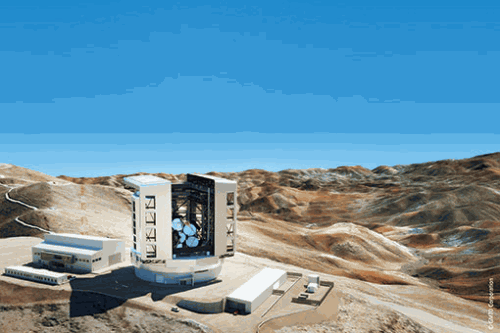
These advances will enable the GMT to capture images of astronomical objects sharper than currently possible by reducing distortions introduced by the terrestrial atmosphere. Scientists and engineers working on similar telescope projects have traditionally built their own automation solutions using custom control components. However, the team that is currently planning the infrastructure for the GMT sees this differently, explains GMT Organisation (GMTO) senior electronics engineer, José Soto: “We want to change the historical method of treating telescopes as special and totally unlike other automated systems. Future-facing industrial control solutions have the power to solve many problems we face today in astrophysics.”
Standards-based automation for a unique project
Specifying automation and control components for the GMT also required careful consideration due to the real-time communication and control requirements, especially considering the system will possess more than 3000 axes of motion. Beyond rotating the telescope’s 22-story-tall enclosure, the flexible mirrors must move with utmost precision to implement the complex adaptive optics in order to achieve the highest possible image resolution.
One example is the active optics system, which requires integration of 170 pneumatic actuators per primary mirror to support the mass of each mirror. The engineering team identified the need for automation and control components that were powerful now, but would also support future advances in technology. Soto adds: “Since these projects take a long time we must account for obsolescence in every aspect. The most effective method of fighting obsolescence is standardising on proven industrial technologies.”
TwinCAT software
TwinCAT 3 automation software from Beckhoff has offered a key platform to test devices, and it is specified for control of the structures around the telescope. “The PC-based controller for the telescope’s enclosure will run TwinCAT directly,” says GMTO engineer, Hector Swett. “It also provides the real-time capability to interface this massive application with the observatory control system via OPC UA. Exemplifying system openness, TwinCAT can automatically scan and configure third-party devices over ADS and EtherCAT, providing an optimal platform for all tasks from sensing to motion control.”
New technologies for creative ideas
EtherCAT first led the GMTO engineers to Beckhoff, and it remains foundational to the telescope’s control architecture design. Soto concludes: “Using EtherCAT as the GMT fieldbus enables real-time communication down to the I/O level. We have achieved cycle times of 2 ms, which allows enough bandwidth to close the loop on a range of subsystems, expanding our control and networking abilities significantly. Compact EtherCAT I/O modules and embedded PCs save space in control cabinets, and because the PC-based controllers can be located at a distance from the I/Os, this reduces heat dissipation.”
In a decade, this process of observation and discovery will not belong to the engineers designing and building the GMT, but to the astrophysicists and cosmologists using it to explore the cosmos. Researchers will have the flexibility to bring their own creative ideas when using the telescope to make great discoveries that cannot yet even be imagined.
| Tel: | +27 11 795 2898 |
| Fax: | 086 603 6868 |
| Email: | [email protected] |
| www: | www.beckhoff.com |
| Articles: | More information and articles about Beckhoff Automation |






© Technews Publishing (Pty) Ltd | All Rights Reserved

 printer friendly version