



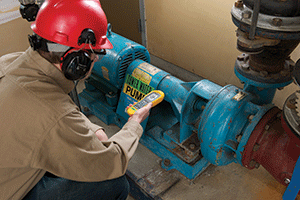
Some of the jobs being performed by today’s technicians don’t even have names or descriptions yet and are being added ‘on the fly’ to keep up with today’s innovative tools and advanced equipment condition-monitoring techniques. What were once complex tasks performed only by reliability engineers or specialised contractors can now be accomplished by less experienced technicians with easy to use tools, such as vibration screeners and thermal imagers. Consequently, this allows analysts and reliability engineers to use their time and expertise more efficiently by examining equipment condition data and making proactive decisions to prevent equipment failure, ultimately saving money.
Train the technician to use high-tech
Recently, a large, globally recognised automobile manufacturer successfully deployed maintenance technicians, who normally repair equipment, to also carry out route-based condition monitoring using handheld vibration meters and thermal imagers.
Like many plants, the manufacturer had started to incorporate new technology into its operations. However, much of the machinery was still not equipped with sensors, and so little or no equipment condition data was being gathered. Also, no regular condition monitoring routes or schedules had been set up. Both the company’s thermographer and reliability team supervisor understood the value of equipment condition monitoring concerning proactive maintenance to extend equipment life. They decided to put vibration screening meters and infrared thermal imaging tools to the test.
“Our main reason for testing these tools was to see if we could pass along some of the vibration testing and thermography scans to maintenance technicians so the reliability team could concentrate on the most difficult issues,” said the reliability supervisor. “Right now, we are only able to look at certain pieces of equipment because we only have so much manpower. If maintenance could collect data on more equipment, and the experts could spend their time analysing the data, we could look at everything more frequently. Whatever tools we use have to make it easy for the maintenance techs to upload the data because we want them to be more efficient.”
In the end, the pilot programme proved that techs could be deployed to assist the reliability team. It also provided them with a nice change of pace from some of their usual tasks.
Pairing regular vibration screening with an asset criticality list
With the techs now trained and armed with thermal imaging and vibration screening tools, a natural next step for any manufacturer would be to transition to regular route-based equipment condition monitoring, such as vibration screening.
Obviously, not all equipment is created equal, nor is the failure of a particular machine component, so it makes sense to give more attention to machinery that, should it fail, will have the highest impact on overall production. Many times, the most common culprit for equipment failure is caused by misalignment, looseness, imbalance, bearing wear and motor electrical issues. By implementing route-based vibration screening and by prioritising the right schedule based on an asset criticality list, much of the damage caused by common machine faults can be avoided before it happens.
Prioritise the list
It is imperative to prioritise assets and rank them in order of importance before making schedules, assigning work orders and creating routes. Also, ensure the success by selecting a qualified assessment team familiar with the various pieces of equipment; then the team can use the quality criteria to gain consensus about why a piece of equipment was included, and how it was ranked.
Rank the assets
Once the assets to be included on the list (by type, size, location, etc.) have been decided on, create a numbering system, such as on a scale of 1 to 5 to rank each asset from ‘most critical’ to ‘least critical’ based on importance to overall production and processes. Lastly, add the numbers up to arrive at a criticality ranking for each piece of equipment.
Develop a screening schedule
Now that the asset criticality analysis list is complete, the next step is to establish a preventive maintenance task for each data collection point on the route for accurately screening of machine condition changes. Once the maintenance plan has been established and a fixed route of data collection points is in place, start laying out vibration screening schedules and testing frequencies such as daily, monthly, bi-monthly, quarterly or yearly, depending on the asset criticality ranking and associated risk factors important to the industry, company and plant.
Additionally, identify the appropriate technician or engineer (less experienced, semi-experienced, highly experienced) to address the task, depending on the asset ranking, difficulty of the task and expertise/training needed. For example:
Screening: Schedule junior technicians using electrical, thermal and vibration screening tools to monitor:
• Star machines − daily.
• Critical and semi-critical machines − monthly.
• Non-critical machines − quarterly.
Diagnosis: Schedule mid-level technicians using vibration testers to measure and diagnose faults on:
• Star machines − weekly.
• Critical machines − quarterly.
• Other machines − as needed.
Alignment: Schedule mid-level technicians to perform alignment checks and corrections on:
• Star machines − monthly.
• Critical machines − yearly.
• Other machines − as needed.
Analysis: Schedule senior technicians, engineers or contractors to perform advanced analysis and resonance testing on:
• Star machines − quarterly.
• Critical machines − annually and as needed.
• Semi-critical machines − as needed.
Keep in mind that, although the asset criticality analysis list serves as a strong guide, it also needs to be flexible enough that unique considerations or decisions can be made as needed.
Making proactive, planned stops
Making the switch to a more proactive maintenance approach takes time. Transitioning, or adding to a technician’s skill set early in the process and introducing things like smarter tools will help combat the growing need for a more technologically advanced workforce and will make each consecutive addition to the programme that much easier. Additionally, by adding condition monitoring, based on an asset criticality list, companies can improve both personnel and plant efficiency and take quality, proactive actions based on data, to prevent equipment failures before they happen. Remember that reliability is a journey and not a destination. Never stop documenting successes, or else a new directive will cancel the great accomplishments that have been seen with the reliability programme.
What’s the next step?
One consideration might be the addition of a cloud-based computer maintenance management system (CMMS), such as eMaint, which allows access to data from Fluke Connect-enabled handheld tools using a desktop, smartphone or tablet. In conjunction with tools such as thermal imagers and vibration screening tools, a CMMS easily connects workers like technicians and reliability engineers to critical historical and real-time data − anytime, anywhere.
Vibration meter optimised for route-based maintenance
Fluke’s guiding value is that its customers’ opinions, needs and wants are closely listened to, and as a consequence the Fluke meters are continuously improved. The Fluke 805FC Vibration meter now greatly improves the ease of performing vibration screen routes for technicians and managers, enabling better management and monitoring of workflow.
Some of the improved features are:
• Build equipment setups and maintenance routes using Fluke Connect.
• Easily push work orders and routes to the technician’s smartphone via Fluke Connect.
• Add work orders directly to the unit using Fluke Connect mobile App.
• Easily upload results after measurements are made.
• Share and view results remotely, receive alerts when equipment heath changes, and view active trends of multiple parameters.
For more information contact Comtest, +27 10 595 1821, [email protected], www.comtest.co.za
Product: https://bit.ly/3mNjrNg






© Technews Publishing (Pty) Ltd | All Rights Reserved

 printer friendly version