



Other technologies


Paving the way for way for ultra-fast sustainable computers

Second Quarter 2023 Other technologies

The discovery of new quantum materials with magnetic properties are believed to pave the way for ultra-fast and considerably more energy efficient computers and mobile devices. So far, these types of materials have been shown to work only in extremely cold temperatures. Now, a research team at Chalmers University of Technology in Sweden is the first to make a device made of a two-dimensional magnetic quantum material work at room temperature.
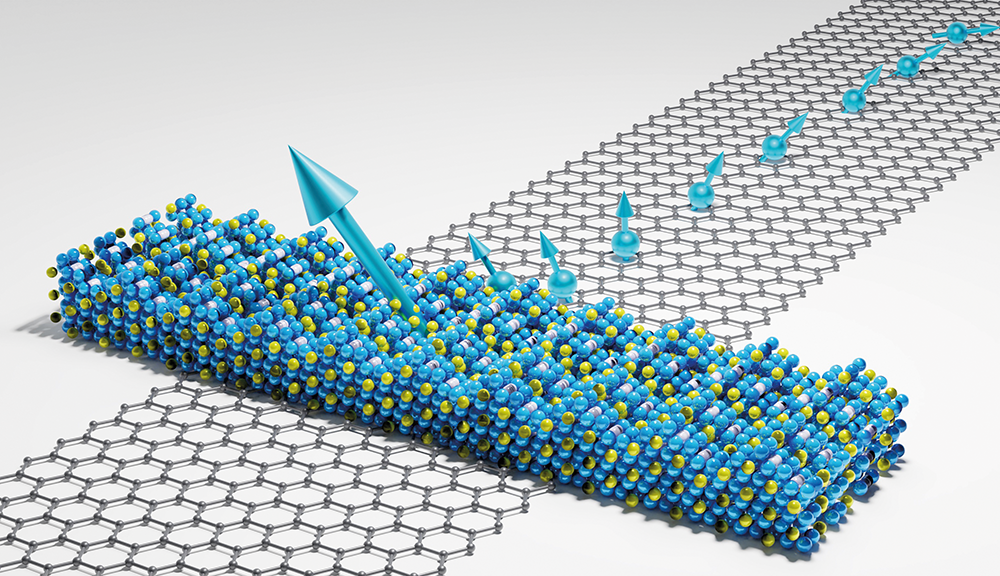
Today’s rapid IT expansion generates enormous amounts of digital data that needs to be stored, processed and communicated. This comes with an ever-increasing need for energy − projected to consume over 30% of the world’s total energy consumption by 2050. To combat the problem, the research community has entered a new paradigm in materials science. The research and development of two-dimensional quantum materials, that form in sheets and are only a few atoms thick, have opened new doors for sustainable, faster and more energy-efficient data storage and processing in computers and mobiles.

The first atomically thin material to be isolated in a laboratory was graphene, a single atom-thick plane of graphite, that resulted in the 2010 Nobel Prize in Physics; and in 2017, two-dimensional materials with magnetic properties were discovered for the first time. Magnets play a fundamental role in our everyday lives, from sensors in our cars and home appliances to computer data storage and memory technologies, and the discovery opened the way for new and more sustainable solutions for a wide range of technology devices.

“Two-dimensional magnetic materials are more sustainable because they are atomically thin and offer unique magnetic properties that make them attractive for developing new energy-efficient and ultra-fast applications for sensors, and advanced magnetic memory and computing concepts. This makes them promising candidates for a range of different technologies”, says Saroj Dash, professor in Quantum Device Physics at Chalmers University of Technology in Sweden.

So far, researchers have only been able to demonstrate two-dimensional magnets in extremely low temperatures in laboratory environments, so-called cryogenic temperatures, inhibiting their broader use in society. The researchers at Chalmers University of Technology have been able to demonstrate, for the very first time, a new two-dimensional magnetic material-based device at room temperature. They used an iron-based alloy (Fe5GeTe2) with graphene, which can be used as a source and detector for spin polarised electrons.

Conventional electronic logic devices are based on nonmagnetic semiconductors and use the flow of electric charges to achieve information processing and communication. Spintronic devices, on the other hand, exploit the spin of electrons to generate and control charge currents, and to interconvert electrical and magnetic signals. By combining processing, storage, sensing, and logic within a single integrated platform, spintronics could complement and, in some cases, outperform semiconductor-based electronics, offering advantages in terms of scaling, power consumption, and data processing speed.

The breakthrough is believed to enable a range of technical applications in several industries as well as in our everyday lives. “These 2D magnets can be used to develop ultra-compact, faster, and more energy-efficient memory devices in computers. They may also be used to develop highly sensitive magnetic sensors for a wide range of applications, including biomedical and environmental monitoring, navigation, and communication,” concludes Bing Zhao, post-doctorate researcher in Quantum Device Physics and first author of the study.




Share this article:
Share via emailShare via LinkedInPrint this page

Further reading:

Oil monitoring solution drives performance gains for paper mill
SKF South Africa Other technologies
By integrating real-time monitoring with precise flow control, SKF’s Flowline oil monitor meters have significantly improved the flow rate control and performance of oil circulation lubrication systems installed on a paper mill.

Read more...
The Konecranes portal, a benchmark in data supply
Other technologies
The newly launched Konecranes Portal takes online communications to the next level through its single point of access to its digital customer platforms

Read more...
Ultra-compact industrial PCs exploit advances in CPU technology
Beckhoff Automation Other technologies
Beckhoff’s C60xx scalable series of ultra-compact industrial PCs combines high computing power in an extremely compact format with a wide range of options for installation in the control cabinet.

Read more...
Anti-wear additives – the metal guardians in your oil
Other technologies
Anti-wear additives are used to protect against wear and the loss of metal surfaces during mixed-film and boundary-film lubrication.

Read more...
OMRON simplifies safety
Omron Electronics Other technologies
OMRON’s NX Safety platform, Online Safety Functional Test Verification is a feature built into the Sysmac Studio engineering environment. This intuitive tool allows safety verification to be carried out digitally, with step-by-step guidance and full traceability, all from a single workstation.

Read more...
Condition monitoring in hazardous areas
SKF South Africa Other technologies
SKF is further strengthening its condition monitoring offer portfolio by a newly developed hazardous area version of its Microlog Analyzer dBX portable vibration analyser.

Read more...
Why AI will never truly understand machines
Other technologies
Cutting-edge technology and solutions powered by AI are embraced by specialist condition monitoring company, WearCheck, where the extreme accuracy of data used to assess and diagnose machine health is paramount.

Read more...
Robotic filling systems for the pharmaceutical industry
Horne Technologies Other technologies
Pharma Integration, a leading pharmaceutical manufacturer, aims to replace traditional mechanical filling lines with compact, fully automated systems that are 100% robot-driven using machines known as Azzurra. Their integrated Faulhaber drives play a crucial role in the fill-finish process, ensuring the highest precision and safety across multiple production steps.

Read more...
World first simulation of error-correctable quantum computers
Other technologies
Quantum computers still face a major hurdle on their pathway to practical use cases, their limited ability to correct the arising computational errors. In a world first, researchers from Chalmers University of Technology in Sweden have unveiled a method for simulating specific types of error-corrected quantum computations.

Read more...
Monitoring vibration allows for equipment longevity
Iritron Other technologies
Unscheduled downtime and maintenance on machines is often a source of frustration for many companies active in industrial manufacturing as it results in loss of process and productivity, which in turn equates to loss of revenue.

Read more...


While every effort has been made to ensure the accuracy of the information contained herein, the publisher and its agents cannot be held responsible for any errors contained, or any loss incurred as a result. Articles published do not necessarily reflect the views of the publishers. The editor reserves the right to alter or cut copy. Articles submitted are deemed to have been cleared for publication. Advertisements and company contact details are published as provided by the advertiser. Technews Publishing (Pty) Ltd cannot be held responsible for the accuracy or veracity of supplied material.


© Technews Publishing (Pty) Ltd | All Rights Reserved