



The idea of using gravity to store energy is not new. Hydro has been a feature of mature electricity grids for decades. While this may be ideal for large-scale storage, it requires very specific geographies and comes with a huge capital cost.
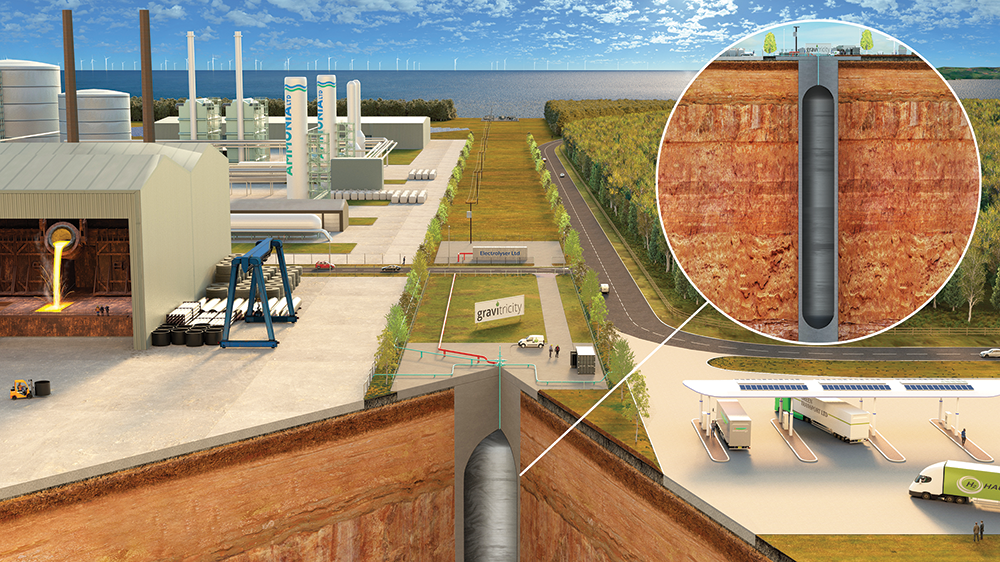
Gravitricity, an Edinburgh-based green engineering startup, is working to make gravity energy storage (GES) a reality.
GES is in principle remarkably simple. When green energy such as solar or wind is plentiful, use it to haul a massive weight to a predetermined height. When it’s limited, release the load to power a generator with the downward gravitational pull. The sheer mass of a gravity battery’s weight, coupled with its incredibly slow descent, generates a huge amount of torque, allowing the system to deliver maximum power almost instantaneously. Gravitricity claims its system can operate for up to 50 years and store energy at half the cost of lithium-ion batteries. Commercial director, Robin Lane says that this technology can cycle rapidly from charge to discharge over many years, without any loss of performance, unlike many other energy storage technologies.
To put it in context, you have to drop 500 tons around 800 metres to generate 1 MWh. “This led Gravitricity inescapably in one direction − underground,” says commercial director, Robin Lane. “By deploying our systems in existing mine shafts, we are able to use weights significantly heavier than anything which could be cost-effectively supported by aboveground structures; and we can drop those weights over longer distances. We are evaluating mine shafts 1000 metres deep, allowing a much greater drop than anything which could realistically be achieved above ground.
“In the future, we plan to build multi-weight systems raising and lowering weights totalling up to 12 000 tonnes in shafts up to 750 metres deep, offering almost 25 MWh of flexible storage. A world of distributed energy generation will require distributed energy storage, so Gravitricity plans to develop systems which can be located at scale anywhere – alongside renewable generation, at the transmission level, in off-grid locations, or in urban centres.”
Gravitricity has successfully trialled its first gravity battery prototype, a 15 metre steel tower suspending a 50 ton iron weight. Electric motors slowly hoist the massive metal box skyward before gradually releasing it back to earth, powering a series of electric generators with the downward drag. The company’s focus is now below ground. Engineers have been scoping out decommissioned coal mines in Britain, Eastern Europe, South Africa and Chile.
Gravitricity is working with Dutch winch and offshore manufacturer, Huisman Equipment to develop a prototype system, and with Czech company, Nano Energies to establish commercial routes to market for GES. To this end, it has signed a memorandum of understanding with Czech State-owned mining enterprise Diamo to transform the former Darkov deep-level coal mine in the country into a 4 MW energy storage facility by lowering and raising a single massive weight suspended in the mine shaft.
Lane says there is vast potential for GES in South Africa to use decommissioned mine shafts beyond their useful lives, instead of having to break down infrastructure and rehabilitate the area. Of particular interest to Gravitricity are the country’s deep level mines.
Public relations manager, Simon Farnan tells SA Instrumentation & Control that the company identified over 30 deep shafts suitable for early projects, and signed MoUs with South African companies UMS Mining Group and RESA. “We are still considering development opportunities in South Africa, and are actively pursuing innovation grants that would help support further research opportunities with our study partners,” he says.
However, before Gravitricity can partner with mining companies in South Africa, it has to validate the capabilities and performance metrics of its technology through the scaled-up system in the Czech Republic, which should be operating in 2024.
“At this stage, our focus is on developing our first commercial projects in the Czech Republic, Germany and the UK,” he explains.
It seems like a neat solution. There are disused mine shafts all over the world deep enough to house a full-sized Gravitricity installation stretching down 300 metres and more. Blair says that there’s the political will to make it happen too, with policymakers keen to tap into public enthusiasm for a just transition.
It’s impossible to know how many of these will come to fruition; but gravity batteries, by harnessing an infinite, omnipresent force, almost certainly have a role to play.






© Technews Publishing (Pty) Ltd | All Rights Reserved

 printer friendly version