

Contaminants such as solid, liquid and gaseous particles are the bane of a hydraulic engineer’s life. Systems over time become less efficient and ultimately break down. This is costly. The problems are generated either externally or internally through fluids, component corrosion or wear and tear, or insufficient system maintenance and housekeeping.
In difficult economic times, system maintenance is often given a low priority. Cost savings exercises are adopted. Users seldom focus on the saving in time wasted on breakdowns and the cost savings that can be achieved through an effective maintenance regime.
Contamination control is a long-term process with ongoing monitoring. Let us examine a few points where incorporating effective filtration and condition monitoring can help with system efficiencies and optimum performance.
Around seventy to ninety percent of hydraulic system breakdowns are attributed to particulate contamination. If a systems engineer can incorporate appropriate filtration and contamination control equipment to reduce contaminants, the system can achieve efficiencies to prolong the working life of the equipment.
Hydrasales sales engineer, Chris Banks, enjoys helping clients with filter sizing. He says, “Filter sizing with the MP Filtri software helps with filter sourcing. Nothing is left to chance. It allows simulation under different flows and pressures. The report computes pressure drops and maximises the opportunity for correct filter selection.”
Components are continuously subjected to contaminants before the actual component failure. A system therefore loses component efficiency right from the time of commissioning. When new, a hydraulic system runs at full pressures and flow rates, and the system loads and speeds are optimal. Over time, contaminants cause wear and cracks at critical component surface areas.
Typically, the tolerances are small, and engineers expect component clearances of 0,5 microns up to 50 microns. It does not take much dirt or contaminant to block an orifice within a hydraulic system. Any blockage or impairment will reduce and ultimately restrict flow within the system, impacting, stopping or slowing down the hydraulic application. How can we control this contamination problem and extend component life?
The first step is to incorporate effective filtration at the design stage of the system. Depending on the sophistication and the need for system outputs, the designer should consider including pressure, return, suction, and an offline filtration system to protect components.
These all do a job but are they the right filters for the application? Hydrasales’ Lucas Thela says, “I would like to offer a word of caution on the approach to designing the system. The cheapest design may meet the minimum operating parameters; but without incorporating effective filtration to meet the operating needs of a system at peak pressures, the outcome can be expensive.” He adds that there is a lack of understanding of the importance of filtration and contamination control. “A basic understanding will go a long way,” he emphasises.
Hydrasales provides full support at the design stage and offers free training on filtration, contamination monitoring and accessories. “With technology we can reach the remotest customers through online platforms,” emphasises general manager, Elvira Caripis. “Internet access is all that is required. This will be beneficial for maintenance and field staff. Training will help participants troubleshoot filter efficiency and performance.”
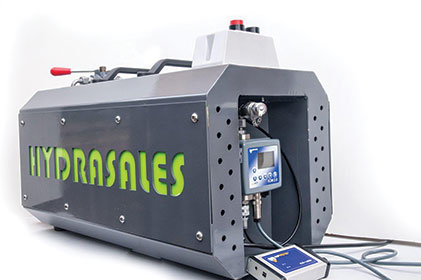
Online particle monitors analyse systems 24/7, initiating internal and external alarms should the levels of contamination deteriorate or moisture levels change. They act as an early warning system.
The benefits of online particle counting are:
• Saving money on the total cost of filtration by eliminating unscheduled filter changes.
• Constant system monitoring = predictive maintenance = cost savings.
• Constant system monitoring = tracking system cleanliness = cost savings.
• Prolonging significant component life with predictive maintenance.
• Saving time – high cost processes are effectively monitored.
• There is predictive control. This is a cost-effective and efficient method of system monitoring, where system cleanliness levels are exceeded.
Hydrasales carries a full range of quality and time-tested hydraulic filters, filter elements and system accessories. The company represents MP Filtri, Faster Couplings and the Badger Meters Hedland range of flow meters. These leading manufacturers meet international standards and products are certified to international quality standards. Hydrasales enjoys direct technical support from these leading brands and this support is key to application development and innovation in African markets.
| Tel: | +27 11 392 3736 |
| Fax: | +27 11 392 6957 |
| Email: | [email protected] |
| www: | www.hydrasale.co.za |
| Articles: | More information and articles about Hydrasales |






© Technews Publishing (Pty) Ltd | All Rights Reserved

 printer friendly version