



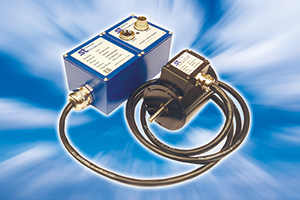
The growing demand for high speed miniature and micro machines has prompted Sensor Technology to develop a torque monitor that can accurately measure down to 10 mNm. This capability is combined with a 50 kHz bandwidth so that even the most fleeting of transient torques can be recorded with accuracy.
Engineering design has a number of ongoing long term trends, including a drive towards ever more compact systems, more accurate measurement and finer resolution of data, increasingly sophisticated information displays and higher operating speeds. Over a period of two or three decades, these are obvious in fields from consumer products to medical equipment to production machinery to transport solutions.
These advances are driven by user demand but enabled by emerging technologies such as electronics and computing. Mark Ingham from specialist sensor manufacturer, Sensor Technology explains: “Most users of our equipment work at the leading edge of technology, developing new solutions for practical engineering or scientific projects.”
The company has now combined increasing electronic data processing speeds and the latest in display systems with new sensing techniques developed in-house to produce a new generation of optical rotary torque sensors that are designed for applications where precise, dynamic measurement of rotary and static torque in the range of 10 mNm to 100 Nm, with high resolution so that even ultra-short torque peaks and troughs can be recorded.
Typical applications include profiling the acceleration and deceleration of high speed motors, controlling micro systems and miniature machinery, collecting data from repetitive scientific experiments and testing industrial machinery to destruction.
Operating principle
The technology behind Sensor Technology’s ORT230/240 optical torque sensor is based on an extensively proven and developed measurement principle whereby two discs with segmented gratings are positioned on a rotating drive shaft a short distance apart so that the opaque sectors on one disc partially obscure the clear sectors on the other. Light passes through the sectors and is detected by photovoltaic detectors. As torque is applied to the shaft, a slight twist results which changes the alignment of the gratings and thus varies the light transmitted through to a detector. The use of this technique results in a transducer which is able to detect torque bi-directionally and which has a fast mechanical and electrical response, low inertia and complete freedom from brushes or complex electronics.
The intensity of the light beams, which is constantly monitored, is modulated by the applied torque and produces an electrical output that is used to provide a precise indication of the torque transmitted by the shaft. The light intensity is automatically controlled within the transducer body by a monitor cell. Very high full scale sensitivity can be achieved with fast electrical responses up to 50 kHz and low inertia. As the measurement is non-contact it also has complete freedom from brushes and complex electronics on the shaft, which are often found in traditional torque measurement systems.
The absence of brush gear and fixed electronics allows high speed operation with a continuous rating up to 30 000 rpm standard. Further increases in speed are available depending upon shaft size. The torque shaft is of low compliance 0,5° maximum torsion deflection on the smaller transducers and 0,25° maximum on the larger transducers at full scale deflection. Any full scale torque can be specified within the range 10 mNm to 100 Nm. The non-contact operation ensures a long and reliable life of accurate operation. The optical operating principle also means there is total immunity to noise corruption.
TorqSense ORT 230 sensors provide fixed voltage or current analog outputs – one for torque and one for either speed or power. The TorqSense ORT 240 provides two user selectable voltage or current analog outputs – one for torque and the other for either speed, power or peak torque – plus digital outputs including RS232, CANbus and USB for interfacing with modern instrumentation and laptops. The ORT 240 enables users to connect up to 10 transducers via USB and transducer configuration software for making changes to transducer variables.
Features of both devices include self-diagnostics to report if the transducer’s torque, speed ratings or calibration date have been exceeded, while inbuilt sensors monitor shaft temperature for better compensation and accuracy. The device also offers a simple ‘sensor status’ output.
| Tel: | +27 10 595 1831 |
| Email: | [email protected] |
| www: | www.instrotech.co.za |
| Articles: | More information and articles about Instrotech |






© Technews Publishing (Pty) Ltd | All Rights Reserved

 printer friendly version