Hydraulic accumulators: know your legal obligations
1st Quarter 2009
Hydraulic systems & components
Users operating hydraulic systems for power transmission purposes may well be inadvertently operating outside of applicable government legislation. Although the applicable regulations are inconsistent, ignorance is no excuse.
Before we begin
This article contains abstracts and interpretations of South African legislation. Users of accumulators should ensure that they comply with all applicable legislation and should not rely solely on the contents and interpretations of the authors or publishers of this article.
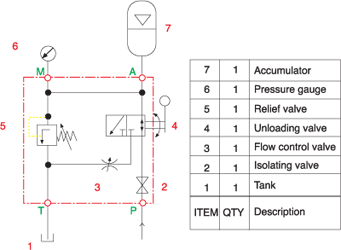
Figure 1. Typical hydraulic safety block for an accumulator
Accumulator whys and wherefores
Hydraulic power systems incorporate accumulators to store energy, thus temporarily supplementing the hydraulic supply to the system.
Sci-Tech Encyclopedia defines an hydraulic accumulator as: “A pressure vessel which operates as a fluid source device or shock absorber. It is used to store fluid under pressure or to absorb excessive pressure increases. The hydraulic accumulator is an energy-efficient component, which allows the use of a smaller pump to achieve the same end results in terms of cylinder rod actuation speeds. In certain circuit designs, the accumulator will permit a pump motor to be completely shut down for an extended period of time while the accumulator supplies the necessary fluid to the circuit.”
Accumulators use various techniques to achieve their purpose:
* Deadweights.
* Spring-loading.
* Hydro-pneumatic systems.
Deadweight accumulators
In these accumulator designs, system pressure works against a piston which supports a weight, so the energy store is in the form of potential energy.
Spring-loaded accumulators
In spring-loaded accumulators the system hydraulic pressure pushes against a piston which is resisted by the compression of one or more springs.
Hydro-pneumatic accumulators
Hydro-pneumatic accumulators, which are also known as compressed gas (or gas-charged) accumulators, are the most common form of accumulator.
A compressed gas accumulator consists of a cylinder with two chambers that are separated by an elastic diaphragm, a totally enclosed bladder, or a floating piston. One chamber contains hydraulic fluid and is connected to the hydraulic line. The other chamber contains an inert gas under pressure (typically nitrogen) that provides the compressive force on the hydraulic fluid. Inert gas is used because oxygen and oil can form an explosive mixture when combined under high pressure. As the volume of the compressed gas changes the pressure of the gas, and the pressure on the fluid, changes inversely.²
Continued on the web
For the complete article visit www.motioncontrol.co.za/+091Q54
For more information contact Norman Hall, Hyflo Southern Africa, +27 (0)11 386 5800, [email protected], www.hyflo.co.za
Further reading:
From question to innovation
Axiom Hydraulics
Hydraulic systems & components
A field question sparked the journey toward a safer solution. When a simple inquiry, “What about the Hilux?”, posed a challenge, it ignited the innovative spirit at Axiom Hydraulics.
Read more...
The ultimate asset protection
CT Hydraulics (Nqoba)
Hydraulic systems & components
Prioritising the prevention of hydraulic fluid contamination is the single most effective way to eliminate the presence of microscopic debris introduced during hose assembly, repairs, or maintenance.
Read more...
Axial piston pump series for next-gen hydraulic applications
Hydraulic systems & components
Moog has launched its new AXP Axial Piston Pump Series, a next-generation hydraulic solution engineered to deliver optimal performance, reliability and cost efficiency for industrial applications.
Read more...
Identifying signs of hydraulic cylinder wear and tear
CT Hydraulics (Nqoba)
Hydraulic systems & components
Recognising the early warning signs of hydraulic cylinder degradation is crucial for preventing costly downtime, ensuring operator safety and maximising the lifespan of your hydraulic systems.
Read more...
How laser cladding delivers 33% more life and maximum ROI in hydraulic cylinders
Hydraulic systems & components
By utilising advanced laser cladding, Honingcraft can help clients achieve a 33% longer life from their components, ensuring they secure the maximum return on their investment.
Read more...
Filtration as a reliability driver in motion control systems
Parker Hannifin - Sales Company South Africa
Hydraulic systems & components
This article highlights the importance of filtration in motion control systems, how contamination affects performance, and what fleet managers, operators and maintenance teams in southern Africa can do to reduce downtime, avoidable wear and costly repairs, aided by Baldwin Filters.
Read more...
Tuning into what your system is telling you
Hydrasales
Hydraulic systems & components
Hydraulic presses can run like clockwork, but often it’s the things you don’t see, or hear, that carry the most telling signs of irregular system health.
Read more...
A guide to common hydraulic system contaminants
CT Hydraulics (Nqoba)
Editor's Choice Hydraulic systems & components
Every engineer, machine designer and maintenance professional understands that the heart of any reliable hydraulic system is its fluid. But the moment that fluid is compromised, your system’s life expectancy and your peace of mind drop dramatically.
Read more...
Making lines safer with smarter connection
Hydrasales
Hydraulic systems & components
Imagine connecting multiple hydraulic lines or a combination of hydraulic, electrical and grease lines with one single, confident movement. That’s the everyday convenience operators get from Faster’s MultiFaster multi-coupling systems.
Read more...
Hydraulic system upgrades to boost performance and save money
CT Hydraulics (Nqoba)
Hydraulic systems & components
Those working with hydraulic or pneumatic systems know that keeping your machinery running at peak performance balances productivity and cost. As systems age, they often become less efficient, requiring more energy and more frequent repairs. The good news is that you don’t always need to invest in an entirely new machine to solve these problems.
Read more...










 printer friendly version