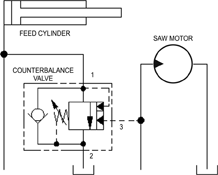
Where the operator controls the feed rate in a cutting circuit, as found in trenching chains, drills, grade trimming wheels or saws, he will typically try to adjust the rate to prevent stall. A problem with this solution is that when the cutting is easy, productivity is lost. The simple circuit shown in Figure 1 may be a better solution in which stalling is eliminated and optimum feed speed maintained.
Figure 1. Incorporating a counterbalance valve in a cutting circuit can eliminate stalling and improve productivity
Operating principle
A counterbalance valve is a direct-acting, pilot-assisted relief valve. Pilot assist at port 3 lowers the effective setting of the relief valve at a rate determined by the pilot ratio. Port 3 of the counterbalance senses the pressure at the cutting device or saw. Port 1 connects to the feed circuit and port 2 goes to tank.
When the pressure required to drive the saw starts to climb too high, the effective setting of the counterbalance is lowered. Feed force will be modulated by relieving the feed circuit to tank, thus preventing the cutting device from stalling.
Design notes
This circuit is all about pressure control as opposed to flow control. Pressure control allows large changes in flow with small changes in pressure. The determining factor in this circuit is the pressure at the cutting device. Do not get too caught up in numbers. There are at least three performance curves involved and trying to predict exactly what will happen is difficult, if not impossible.
In order to serve this purpose, the counterbalance valve has to have enough capacity to handle the flow of the feed circuit. The counterbalance valve will probably need a low pilot ratio and a high setting.
From question to innovation Axiom Hydraulics
Hydraulic systems & components
A field question sparked the journey toward a safer solution. When a simple inquiry, “What about the Hilux?”, posed a challenge, it ignited the innovative spirit at Axiom Hydraulics.
Read more...The ultimate asset protection CT Hydraulics (Nqoba)
Hydraulic systems & components
Prioritising the prevention of hydraulic fluid contamination is the single most effective way to eliminate the presence of microscopic debris introduced during hose assembly, repairs, or maintenance.
Read more...Axial piston pump series for next-gen hydraulic applications
Hydraulic systems & components
Moog has launched its new AXP Axial Piston Pump Series, a next-generation hydraulic solution engineered to deliver optimal performance, reliability and cost efficiency for industrial applications.
Read more...Identifying signs of hydraulic cylinder wear and tear CT Hydraulics (Nqoba)
Hydraulic systems & components
Recognising the early warning signs of hydraulic cylinder degradation is crucial for preventing costly downtime, ensuring operator safety and maximising the lifespan of your hydraulic systems.
Read more...Filtration as a reliability driver in motion control systems Parker Hannifin - Sales Company South Africa
Hydraulic systems & components
This article highlights the importance of filtration in motion control systems, how contamination affects performance, and what fleet managers, operators and maintenance teams in southern Africa can do to reduce downtime, avoidable wear and costly repairs, aided by Baldwin Filters.
Read more...Tuning into what your system is telling you Hydrasales
Hydraulic systems & components
Hydraulic presses can run like clockwork, but often it’s the things you don’t see, or hear, that carry the most telling signs of irregular system health.
Read more...A guide to common hydraulic system contaminants CT Hydraulics (Nqoba)
Editor's Choice Hydraulic systems & components
Every engineer, machine designer and maintenance professional understands that the heart of any reliable hydraulic system is its fluid. But the moment that fluid is compromised, your system’s life expectancy and your peace of mind drop dramatically.
Read more...Making lines safer with smarter connection Hydrasales
Hydraulic systems & components
Imagine connecting multiple hydraulic lines or a combination of hydraulic, electrical and grease lines with one single, confident movement. That’s the everyday convenience operators get from Faster’s MultiFaster multi-coupling systems.
Read more...Hydraulic system upgrades to boost performance and save money CT Hydraulics (Nqoba)
Hydraulic systems & components
Those working with hydraulic or pneumatic systems know that keeping your machinery running at peak performance balances productivity and cost. As systems age, they often become less efficient, requiring more energy and more frequent repairs. The good news is that you don’t always need to invest in an entirely new machine to solve these problems.
While every effort has been made to ensure the accuracy of the information contained herein, the publisher and its agents cannot be held responsible for any errors contained, or any loss incurred as a result. Articles published do not necessarily reflect the views of the publishers. The editor reserves the right to alter or cut copy. Articles submitted are deemed to have been cleared for publication. Advertisements and company contact details are published as provided by the advertiser. Technews Publishing (Pty) Ltd cannot be held responsible for the accuracy or veracity of supplied material.









 printer friendly version