


The robotics market is booming and Motion Control’s editor recently chatted to Yaskawa Southern Africa’s MD, Andrew Crackett, to find out how the company is rising to the challenge.
Crackett says that Yaskawa Southern Africa has installed more than 2500 Motoman robots. The company’s main target market is automotive, having cut its teeth here when Terry Rosenberg first started up the business in 1991. More recently it has refocused on pick-and-pack applications and palletising of fertilisers and cements. “In this way we don’t have all our eggs in one basket,” he explains.
In southern Africa, handling is a growing market, especially in palletising applications in large breweries and bakeries. In addition to this, many of Yaskawa’s customers are small and have robotised in niche markets such as sanding, polishing and finishing. Crackett estimates that Yaskawa’s market share in southern Africa is of the order of 40%.
The company is also very active in the area of skills development and the Yaskawa Academy offers a range of globally recognised and certified training courses countrywide. “Rather than losing their jobs, operators are being upskilled,” he adds.
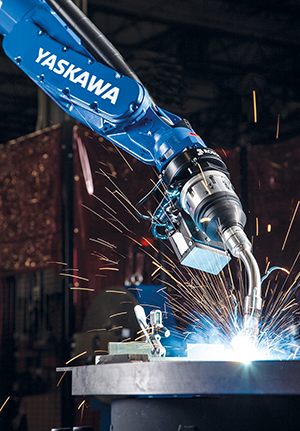
The world of welding is developing very fast and Yaskawa is in discussions with the South African Institute of Welding to offer practical solutions to bridge the gap between manual and robotic welding. An example is a package called Weld4Me. Rather
than learning to program, the welder can take the arm of the robot and guide it by hand. Using his welding skills he creates a sequence and sets the parameters, putting a welding sequence in motion. Crackett believes that robot upskilling is the only way forward if we are to align with international manufacturing. Instead of taking away jobs, it has a positive knock-on effect for the entire manufacturing industry in South Africa.
This goes far beyond welding. He explains that the introduction of robotics in the automotive industry has massively increased efficiency and quality, bringing with it job creation. “We are creating many more jobs up and down the value chain in areas such as moving materials upstream and downstream, sales and transporting new vehicles,” he continues. “More vehicles translates to more robots and more jobs. The whole spectrum is affected by this increase in manufacture, not just the welder.”
Robots are key players in the Covid era. If processes are automated they remove the human factor in the workforce. With no end to the pandemic in sight, business owners are robotising in order to maintain sustainability. Crackett says that during the first lockdown Yaskawa saw a dip in sales, but managed to save the year. “We have had a fantastic first half to this year and are driving to finish in a strong position. Covid has showed us the opportunities and made us more self-sufficient,” he continues. “For example, we installed a laser welding system ourselves, where normally we would have called for help from Europe. This was a huge achievement for our team. The result is that we can now quote as a local project − we have confidence in our ability and skill in these projects.”
“We are a key element of Yaskawa‘s EMEA group and a valuable part of the global picture,” he adds. We are passionate about robots. If you see a gap and believe robotics can be a solution we can show you what’s needed and what’s possible. “We look at the application and specify the correct robot − it’s about managing our clients’ expectations and making sure everyone is on board to get a return on their investment.”
Looking forward, Crackett says Yaskawa’s five year goal is to tackle the handling market in pick-and-pack and palletising in all sectors, to meet growing demand and to establish robotics as an accessible option for South African businesses of all sizes. “The dream is to push local manufacturing. There is massive potential in South Africa and we are capable of doing it ourselves. We should be employing robots and we should focus on manufacturing for ourselves using automation to improve our efficiency and our manufacturing abilities so we can meet demands and reduce costs while upskilling our people. We need to step up, deploy, upskill and create opportunities. Everything is there, we just need to get out and do it,” he concludes.






© Technews Publishing (Pty) Ltd | All Rights Reserved

 printer friendly version