Hydraulic connectors with residual pressure
First Quarter 2024
Editor's Choice
Hydraulic systems & components
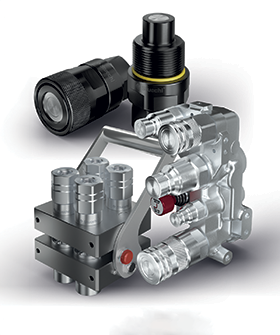
Hydraulic connections are vital in both outdoor industrial machinery, for example in agriculture and earthmoving, and in indoor industrial machinery for presses and moulding. Examples include farm tractors attaching to various implements, or excavators using tools like hydraulic hammers or buckets. The goal is to enable quick, easy swaps to enhance machine flexibility and productivity.
In the past, connecting hydraulic lines involved manually unscrewing couplings on oil-filled hoses, leading to significant oil spillage and environmental pollution. With their occlusion valves, modern quick couplings have largely addressed this by retaining fluid post-disconnection on both the hose and machine side. However, challenges arise when machines or hoses heat up in the sun, causing oil expansion and creating high residual pressure in the lines, up to 100 bar. While certain machines have circuits to mitigate this, and hoses can act as accumulators, the residual pressure often makes connecting quick couplings difficult. Under pressure, the occlusion valves become like rigid hydraulic cylinders, which are hard to connect manually. For instance a common 1,3 cm hose coupling valve has a hydraulic pushing area of 1,5 cm2, translating to a theoretical hydraulic force of 150 kg at 100 bar pressure.
Operators use various methods to overcome this challenge. Some apply excessive force, risking damage to seals and valves. Others strike occlusion valves against hard surfaces to release oil and reduce pressure, leading to environmental pollution and equipment damage. Loosening pipe fittings to drain oil is another method, although it poses safety risks like high-speed oil spray.
The residual pressure problem incurs costs like wasted time, reduced lifespan of quick valves, machine downtime and potential damage to the brand image. Thanks to the 60 years of field experience of Stucchi Italy, Stucchi South Africa offers various technical solutions to these issues. Innovations include a double internal valve system in the APM series, and A-HD and FAP couplings for manual connection without fluid loss. The screw-to-connect system used in the VP, VEP and VEP-HD series allows easier connection against internal pressure. Stucchi’s latest technology also features a manual knob on the Saturn cast iron block, activating an internal valve to drain excess oil for safe, effortless connections.
Further reading:
From the editor's desk: A new era
Technews Publishing
Editor's Choice
After fifteen years as editor of Motion Control, the time has come for me to hand over to Andrew Seldon. It has been a privilege to be part of this publication and to witness not only the remarkable advances in motion control, fluid power and automation, but also the enormous changes in the world around us.
Read more...
OMRON Robotics demos next-generation autonomous mobile robots
Editor's Choice News & events Robotics & Mechatronics
Advancing smarter material flow with the all-new LD-150 and LD-300 AMRs, OMRON Robotics demonstrated the next generation of its flagship LD series autonomous mobile robots (AMRs) at Automate 2026 in June.
Read more...
The hidden heroes who shape Africa’s industrial future
Bosch Rexroth Africa
Editor's Choice News & events
Behind every industrial success story, there’s a human one. Their names may never appear on a project signboard or in a headline. Yet their expertise and determination keep industries moving every day.
Read more...
Bühler Southern Africa leads industry dialogue on apprenticeships
Editor's Choice News & events
Bühler Southern Africa brought together representatives from industry, government and international organisations on
30 June 2026 to explore how quality apprenticeships can help bridge the gap between high youth unemployment and industry demand for skilled technical workers.
Read more...
Why lubrication fails in mining and what to do about it
Editor's Choice Electrical switching & drive systems & components
Lubrication Engineers explains the recurring failure points behind mining lubrication problems and how the right product, storage and application practices can improve equipment reliability.
Read more...
Solving common automation challenges with Festo’s servo drive and servo motor solutions
Festo
Editor's Choice Electrical switching & drive systems & components
Automation projects face challenges that include limited installation space, the need for precise and repeatable linear motion, rising cycle-speed demands, and seamless integration with existing control architectures. Festo’s servo portfolio directly addresses these issues with compact, modular drive and motor solutions designed for specific applications.
Read more...
Inside the Giant Magellan Telescope with mechanical engineering at astronomical scale
Editor's Choice Electrical switching & drive systems & components
Construction of the Giant Magellan Telescope, set to become the world’s largest Gregorian optical infrared telescope, is well underway. While its scientific mission is to transform astronomy, its performance depends heavily on advanced mechanical, hydraulic and pneumatic engineering.
Read more...
Jendamark catalyst shrinking technology leverages SEW-EURODRIVE precision
SEW-EURODRIVE
Editor's Choice Electrical switching & drive systems & components
Innovative technology for shrinking catalytic converters, designed and built in South Africa by Jendamark Automation for the global market, relies on the precision of SEW-EURODRIVE’s highly dynamic servo-geared units and software.
Read more...
Motion control for flight simulators
Beckhoff Automation
Editor's Choice Electrical switching & drive systems & components
Turkish specialist, SANLAB is a leader in motion platforms and simulation technologies. At the heart of these platforms are application-specific servo drives, servomotors and industrial PCs for real-time control, which are supplied by Beckhoff.
Read more...
PC-based control for additive machine tools
Beckhoff Automation
Editor's Choice Electrical switching & drive systems & components
IRPD is a specialist in additive machine tools. Development is heavily focused on high system throughput and consistently high process quality. This goal was achieved with the help of PC- and EtherCAT-based control and drive technology from Beckhoff.
Read more...









 printer friendly version