


A Business Day headline recently cried: ‘Oil prices rise as energy markets tighten’. The price of Brent Crude has soared from $20 a barrel in April 2020 to $85 a barrel currently − an increase of 325% “This poses a serious challenge to hydraulic maintenance staff,” says Hydrasales general manager, Elvira Caripis. “Once again hydraulic oil becomes black gold. At these high prices, can our industry afford to dump thousands of litres of oil?”
Design engineers and service providers should not neglect equipment and system maintenance. There may be temptations to extend the service cycle or delay maintenance timespans. The quality of the oil should not be compromised.
There are always risks of increasing particle contamination and corrosion of the equipment, with resultant equipment failure. Oil analysis and monitoring is required to assess contamination, the chemical composition, levels of water content as well as viscosity which may result in the need for an oil change.
MP Filtri, a global brand in hydraulic filtration and accessories, recommends well maintained and clean systems. Contamination specialist, Geoff Grant and consultant, Mike Day, observe: ”In a study by Dr E. Rabiniwicz of the Massachusetts Institute of Technology, the observation was made that 70% of component replacement is due to surface degradation. In hydraulic and lubricating systems, 20% of these replacements result from corrosion, with 50% resulting from mechanical wear. Most hydraulic systems will generate contamination externally or internally through fluids, component wear and tear, or just bad housekeeping. These contaminants can ultimately cause system inefficiencies or failures. The bottom line is costly repairs, system downtime and production decline.”
They summarise the requirements for monitoring fluid cleanliness as follows:
• The need to measure relatively low concentrations of small particles from four micron upwards.
• The need to measure a wide range of particle sizes and particle concentrations.
• The ability to present data in an industry acceptable form e.g. cleanliness coding systems such as ISO 4406 or AS 4059.
• Approval by the ISO Committee developing particle counting standards for the hydraulics industry.
• Proven accuracy and repeatability.
• The need to provide results immediately or in a short time so that corrective actions can be effected with minimum delay.
• The ability to analyse a wide range of fluid types such as hydraulic, lubrication, wash and solvent fluids.
• An acceptable cost.
Hydrasales distributes a full range of MP Filtri hydraulic filters and accessories and offers a free service to help with filtration sizing through the MP Filtri Filter Sizing software and to provide full technical support. Hydrasales sales manager, Cheryl Johnson, says: “We have had remarkable results in using the software, which has helped tremendously in identifying the appropriate filter for an application.” The end result is a comprehensive report that identifies the viscosity of the filter fluid at the specified temperature that affects the pressure drop or differential pressure. Detailed drawings are produced, with 3D modelling available for upload to drawing programs.
It is vital to enter the required application data such as system pressure, flow rate, operating temperature, oil type and viscosity, thereby ensuring the most appropriate filter calculation. When searching for components, the user will only have to enter the model, or the type of pump, or the motor data for shaft couplings, spider and bellhousing results.
Mobile filtration units
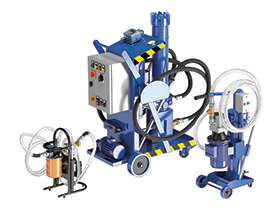
Specialising in particle counters and hydraulic filtration, MP Filtri provides a complete set of high-tech, fixed or portable engineering solutions measuring the levels of fluid contamination. Mobile filtration units provide the perfect solution for the maintenance of lubrication oil and hydraulic fluids in off-line filtration applications. With a versatile and compact design, they are used to pre-filter, transfer or condition hydraulic fluids from existing circuits to new ones, or to clean existing ones during oil changes, filling and flushing, as well as removing any water residues. Available for different flow rates, they can be equipped with an MP Filtri device for online contamination monitoring with the ICM Contamination monitor, according to ISO4406.
“Engineers must incorporate processes to check the quality of the oil, the levels of moisture and the effectiveness of the systems filtration. They must also monitor the levels of contaminants by obtaining data from a contamination condition monitor, ensure the system temperature is within the specified tolerances, check on accessories such as breathers and conduct regular testing of flow and pressures to check compliance with the system parameters,” concludes Banks.
| Tel: | +27 11 392 3736 |
| Fax: | +27 11 392 6957 |
| Email: | [email protected] |
| www: | www.hydrasale.co.za |
| Articles: | More information and articles about Hydrasales |






© Technews Publishing (Pty) Ltd | All Rights Reserved

 printer friendly version